
Why Fixed Deposits May Be a Poor Long-Term Investment Once You Have an Emergency Fund in Sri Lanka
Fixed deposits are not necessarily bad investments. They are useful for protecting money, earning predictable interest and keeping funds relatively safe. However, once you already have a sufficient emergency fund, placing all your additional savings in fixed deposits may prevent your money from growing meaningfully over the long term.
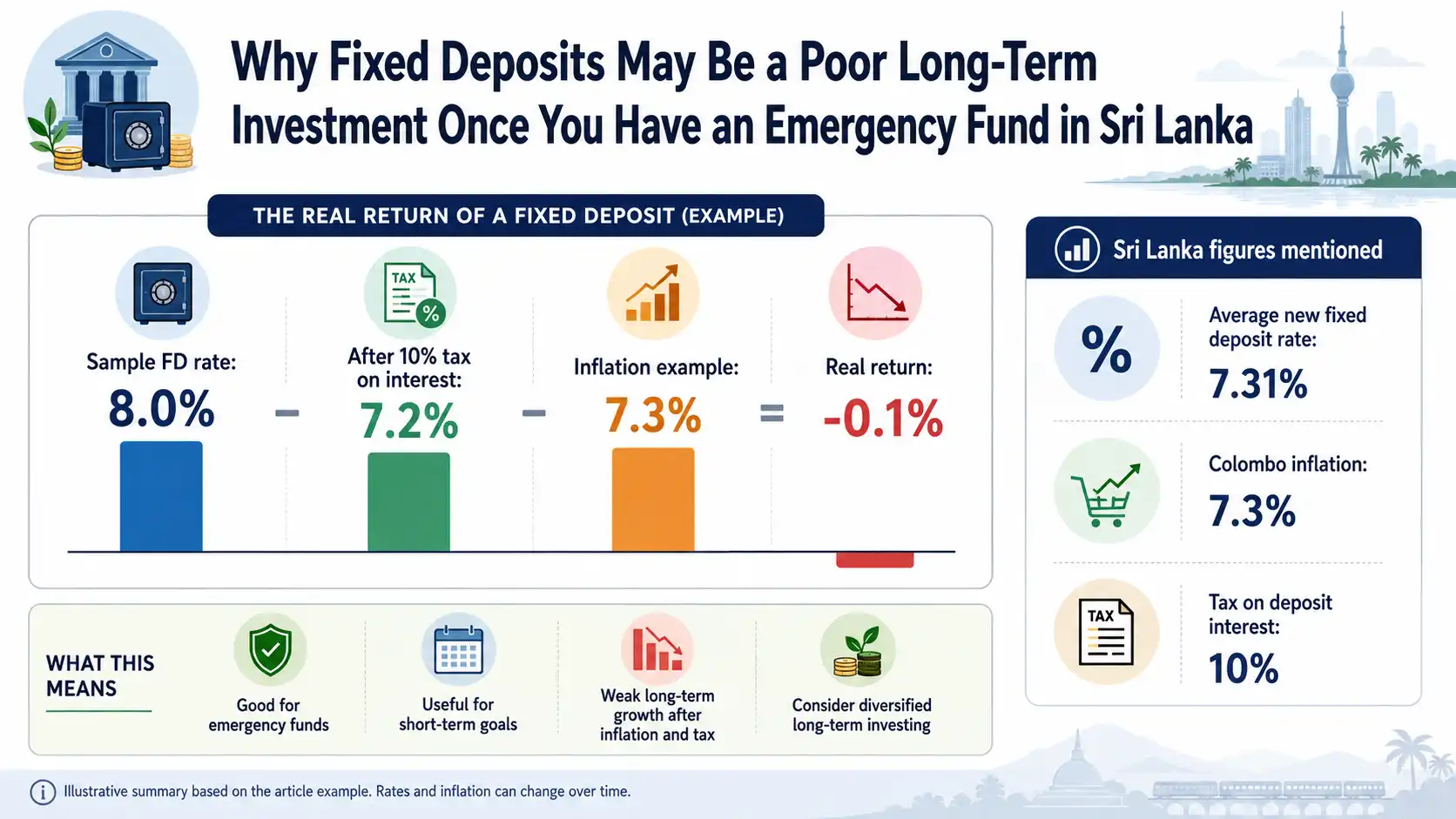
The main problem is the difference between the advertised interest rate and the real return you receive after inflation and taxes.
For example, Central Bank data showed that the average rate offered on new fixed deposits was approximately 7.31% at the end of April 2026. Meanwhile, Colombo’s year-on-year inflation reached 7.3% in July 2026. These figures are from different months and individual banks may offer higher rates, but they demonstrate how easily inflation can consume most of an FD’s return.
Interest earned from deposits is also generally subject to 10% Advance Income Tax. People without taxable income may be able to submit a valid self-declaration, but for other depositors, tax reduces the amount they actually receive.
Suppose an FD pays 8% annually. After a 10% deduction from the interest, the effective return becomes approximately 7.2%. When inflation is close to or above that level, the value shown in your bank account increases, but its purchasing power may barely improve.
Fixed deposits also create an opportunity cost. Money locked into an FD cannot easily be used for another investment without waiting for maturity or accepting reduced interest. When the deposit matures, the available rate may also be lower, creating reinvestment risk.
This does not mean that emergency savings should be moved into shares or other volatile investments. Emergency money must remain safe and accessible. Fixed deposits can also make sense for money required within the next one to three years, such as funds for education, a vehicle or a house deposit.
The weakness appears when FDs become the only long-term investment. Money that will not be needed for many years may benefit from a diversified approach involving government securities, regulated unit trusts, carefully selected equity investments or investments in skills and productive businesses. Each option has different risks, and higher potential returns are never guaranteed.
The practical approach is to give every portion of your money a purpose. Keep your emergency fund safe. Protect money needed for short-term goals. But for long-term wealth creation, relying entirely on fixed deposits may be too conservative—especially when inflation and taxes leave very little real growth.
What do you guys think?



Join the discussion
Start the discussion.