
EPF in Sri Lanka: How Much Will You Have at 55? Contributions, Interest, Balance & Withdrawal Explained
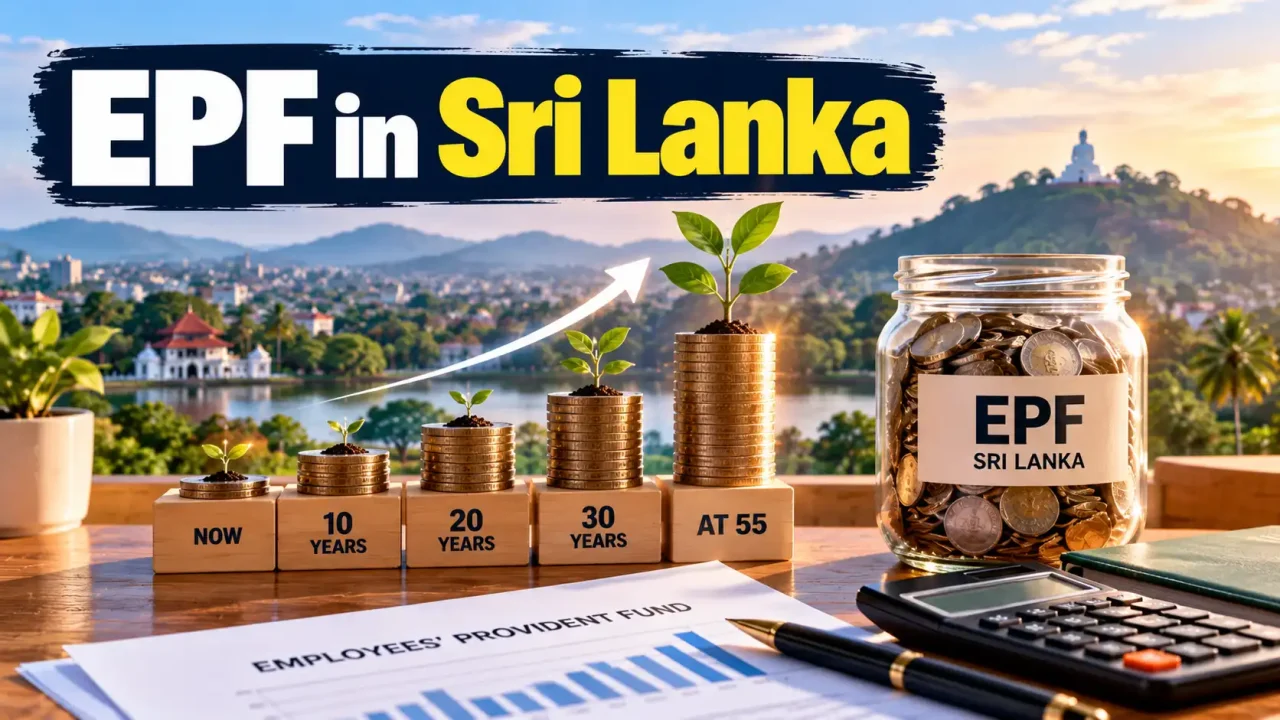
If you earn Rs. 250,000 per month today, how much could you actually have in your EPF account by the time you reach 55?
Rs. 10 million?
Rs. 20 million?
Rs. 50 million?
The answer can be much larger than many employees expect because your EPF doesn’t contain only the 8% deducted from your salary.
Your employer normally contributes another 12%, meaning a total of 20% of your qualifying monthly earnings goes into EPF.
Then the balance earns interest declared by the EPF each year.
For example, the latest declared EPF interest rate is 10.75% for 2025.
But that doesn’t mean everyone should simply calculate:
20% contributions + 10.75% forever.
EPF interest changes from year to year, salaries change, contributions may be missing or delayed, and inflation determines what your eventual retirement balance can actually buy.
Let’s look at how EPF works in Sri Lanka, how much you could accumulate by retirement, how to check your balance, when you can withdraw it and several rules employees frequently misunderstand.
EPF Sri Lanka: Quick Summary
| Item | Current Position |
|---|---|
| Employee EPF contribution | Minimum 8% |
| Employer EPF contribution | Minimum 12% |
| Total EPF contribution | 20% of qualifying monthly earnings |
| ETF | Separate 3% employer contribution |
| Latest declared EPF interest rate | 10.75% for 2025 |
| 2026 EPF interest rate | Not yet declared |
| Full EPF claim age – Male | 55 |
| Full EPF claim age – Female | 50 |
| Must leave employment to claim based on age | Yes |
| 30% pre-retirement withdrawal | Available for qualifying housing/medical purposes |
| Minimum service for 30% withdrawal | 10 years |
| Minimum EPF balance for 30% withdrawal | Rs. 300,000 |
| Maximum 30% withdrawal | Rs. 2 million |
| Full EPF refund taxable? | Official EPF FAQ says No |
| EPF balance available online | Yes, after EPF e-Service registration |
What Is EPF?
The Employees’ Provident Fund, or EPF, is Sri Lanka’s main mandatory retirement savings scheme for covered private-sector and semi-government employees who aren’t entitled to a Government pension.
The employee and employer contribute money throughout the person’s working life.
That money is held in the member’s EPF account and invested by the Fund.
The Central Bank acts as custodian and manages the Fund’s investments, while the Department of Labour handles important administrative matters including membership and benefit claims.
The basic idea is simple:
You work → you and your employer contribute → EPF invests the money → interest is credited → you eventually receive the accumulated fund.
How Much EPF Is Deducted From Your Salary?
The statutory minimum contribution is:
Employee: 8%
Employer: 12%
Total:
20%
But only the employee’s 8% is deducted from the employee’s earnings.
The employer’s 12% is an additional employer contribution.
Example: Rs. 100,000 Monthly Earnings
Employee contribution:
Rs. 100,000 × 8%
= Rs. 8,000
Employer contribution:
Rs. 100,000 × 12%
= Rs. 12,000
Total going to EPF:
Rs. 20,000 per month
So although you see Rs. 8,000 deducted from your salary, your EPF account should receive a total contribution of Rs. 20,000, subject to the applicable earnings calculation.
EPF Contributions at Different Salaries
Here is a simple comparison.
| Monthly EPF-Eligible Earnings | Employee 8% | Employer 12% | Total EPF per Month |
|---|---|---|---|
| Rs. 100,000 | Rs. 8,000 | Rs. 12,000 | Rs. 20,000 |
| Rs. 150,000 | Rs. 12,000 | Rs. 18,000 | Rs. 30,000 |
| Rs. 200,000 | Rs. 16,000 | Rs. 24,000 | Rs. 40,000 |
| Rs. 250,000 | Rs. 20,000 | Rs. 30,000 | Rs. 50,000 |
| Rs. 300,000 | Rs. 24,000 | Rs. 36,000 | Rs. 60,000 |
| Rs. 400,000 | Rs. 32,000 | Rs. 48,000 | Rs. 80,000 |
| Rs. 500,000 | Rs. 40,000 | Rs. 60,000 | Rs. 100,000 |
| Rs. 1,000,000 | Rs. 80,000 | Rs. 120,000 | Rs. 200,000 |
You can calculate your own contribution using Peak Lanka’s Sri Lanka EPF & ETF Calculator.
EPF Isn’t Necessarily Calculated Only on Your Basic Salary
This is another common misunderstanding.
EPF is based on applicable total monthly earnings, not necessarily only the figure called “basic salary” on your payslip.
Official EPF guidance includes items such as:
- Salary or wages
- Cost-of-living allowances
- Certain similar allowances
- Holiday payments
- Food allowances
- Commissions
- Piece-rate payments
- Certain contract-based remuneration
within the earnings calculation, subject to the EPF rules.
Therefore:
Basic salary = Rs. 100,000
doesn’t automatically mean:
EPF is calculated on exactly Rs. 100,000
if other qualifying earnings are also being paid.
If you’re uncertain, compare your employer’s EPF calculation with the official earnings rules.
EPF and ETF Are NOT the Same Thing
Sri Lankan employees often say:
“EPF/ETF”
as if it were one account.
They’re different funds.
EPF
Employee contributes:
8%
Employer contributes:
12%
Total:
20%
ETF
Employer contributes another:
3%
The employee doesn’t contribute that 3%.
So the total statutory EPF + ETF amount associated with qualifying earnings is:
23%
But the 3% ETF contribution does not go into your EPF account.
If your monthly earnings are Rs. 250,000:
Employee EPF:
Rs. 20,000
Employer EPF:
Rs. 30,000
Employer ETF:
Rs. 7,500
Total EPF + ETF contribution:
Rs. 57,500
But only:
Rs. 50,000
is going into EPF.
Peak Lanka’s EPF & ETF Calculator shows the breakdown separately.
Does EPF Earn Interest?
Yes.
Your accumulated EPF balance earns an interest rate declared for the relevant year.
However, the rate isn’t permanently fixed.
It depends on the performance of the Fund and the applicable approval process.
Recent declared rates demonstrate how much it can change.
| Year | EPF Interest Rate |
|---|---|
| 2021 | 9.00% |
| 2022 | 9.00% |
| 2023 | 13.00% |
| 2024 | 11.00% |
| 2025 | 10.75% |
The latest available rate is therefore:
10.75% for 2025.
What Is the EPF Interest Rate for 2026?
As of 3 November 2026, the final 2026 member interest rate has not yet been declared.
That makes sense because 2026 hasn’t finished.
So be careful with websites or social-media posts claiming:
“EPF interest rate 2026 = 10.75%”
10.75% is the declared rate for 2025.
It shouldn’t automatically be assumed for 2026.
Where Does EPF Invest the Money?
EPF doesn’t simply leave trillions of rupees in a bank account.
The Fund invests contributions.
At the end of 2025, the majority of EPF’s investment portfolio was in Treasury Bonds.
EPF also earns income from other financial assets and dividends.
According to the Fund’s official 2025 information, it earned a gross investment income of more than Rs. 553 billion and reported a return on average investment of 11.81% for the year.
After relevant expenses and taxation, an interest rate of 10.75% was declared on member balances.
The exact portfolio naturally changes over time.
How Does Interest Make Such a Big Difference?
Imagine you’re 35 years old and earn:
Rs. 250,000 per month
Your combined employee + employer EPF contribution is:
Rs. 50,000 per month
Over 20 years, without any investment return:
Rs. 50,000 × 12 × 20
= Rs. 12 million
But your EPF doesn’t simply accumulate contributions without earning anything.
If the balance earns returns over time, earlier contributions have many years to earn interest.
That’s compounding.
How Much Could Rs. 250,000 Salary Produce by Age 55?
Let’s create a simple illustration.
Assume:
- Current age: 35
- Retirement age used for illustration: 55
- Monthly earnings: Rs. 250,000
- Monthly EPF contribution: Rs. 50,000
- No existing EPF balance
- Salary never increases
- Contributions continue every month
Now change only the average investment return.
| Illustrative Average Return | Approximate Balance at 55 |
|---|---|
| 0% | Rs. 12.0m |
| 6% | Rs. 22.7m |
| 8% | Rs. 28.4m |
| 10.75% | Rs. 39.2m |
This demonstrates the power of long-term compounding.
But don’t interpret the final row as a forecast.
It assumes the latest 2025 EPF interest rate of 10.75% continues for twenty years.
Nobody knows that.
Future EPF rates could be:
- Higher
- Lower
- Highly variable
The 8% scenario is useful for illustrating how the mathematics works, not predicting the EPF’s future performance.
How Much Could You Have at 55?
Here’s a broader illustration using an 8% average annual return.
Assumptions:
- You start with zero EPF today.
- Your salary never changes.
- Your combined EPF contribution remains 20%.
- Contributions continue every month.
- Average return remains 8%.
- No withdrawals are made.
| Current Age | Years to 55 | Rs.100k Salary | Rs.250k Salary | Rs.500k Salary |
|---|---|---|---|---|
| 25 | 30 years | Rs. 28.2m | Rs. 70.4m | Rs. 140.9m |
| 30 | 25 years | Rs. 18.2m | Rs. 45.4m | Rs. 90.9m |
| 35 | 20 years | Rs. 11.4m | Rs. 28.4m | Rs. 56.9m |
| 40 | 15 years | Rs. 6.8m | Rs. 16.9m | Rs. 33.8m |
| 45 | 10 years | Rs. 3.6m | Rs. 9.0m | Rs. 18.0m |
These are illustrative calculations, not official EPF projections.
In reality:
- Your salary will probably change.
- Contribution amounts will change.
- EPF interest will vary.
- You may already have a balance.
- You may temporarily stop contributing.
- You may make an eligible pre-retirement withdrawal.
But the table highlights something important:
Time matters enormously.
Starting at 25 vs 35 Makes a Huge Difference
Consider someone earning a constant Rs. 250,000 and using our 8% illustration.
Start at age 25:
Around Rs. 70.4 million at 55
Start at age 35:
Around Rs. 28.4 million
The younger worker contributed for only ten additional years.
But the difference is:
Around Rs. 42 million
Why?
The first decade’s contributions have an additional decade to compound.
This is why retirement saving becomes much harder when you try to catch up near retirement.
What If Your Salary Increases?
The previous table deliberately assumes your salary never changes.
That’s unlikely over a 20- or 30-year career.
Suppose you’re 35 and currently earn:
Rs. 250,000
and your earnings rise by an average:
5% each year
If EPF contributions grow with those earnings and the Fund earns an illustrative average 8% return, the projected balance at 55 could be approximately:
Rs. 41.6 million
instead of around:
Rs. 28.4 million
with a completely flat salary.
Again, this isn’t a forecast.
A 5% salary increase every year isn’t guaranteed.
The example simply demonstrates another important point:
Your EPF contribution grows when your EPF-eligible earnings grow.
What If You Already Have Rs. 2 Million in EPF?
Existing savings matter too.
Suppose you’re:
35 years old
Current EPF balance:
Rs. 2 million
Monthly earnings:
Rs. 250,000
New EPF contribution:
Rs. 50,000 per month
Using our illustrative 8% average return:
Existing Rs. 2 million + future contributions could grow to approximately:
Rs. 37.8 million by age 55
Compare that with:
Rs. 28.4 million
if you started with zero.
Your existing Rs. 2 million itself has another twenty years to grow.
But Rs. 30 Million in 20 Years Is NOT Rs. 30 Million Today
This is probably the most important financial warning in this article.
Imagine our 35-year-old employee accumulates:
Rs. 28.4 million at age 55
That sounds like a large amount today.
But retirement is twenty years away.
If inflation averaged 5% annually over those twenty years, Rs. 28.4 million in twenty years would have purchasing power roughly equivalent to only:
around Rs. 10.7 million today
under a simple inflation-adjustment calculation.
That doesn’t mean EPF is bad.
It means you shouldn’t look at a future nominal balance and assume it will buy what the same number of rupees buys today.
This is also why relying only on EPF for retirement may not be enough for many higher-income households.
Peak Lanka’s guide How Much Money Do You Need to Retire in Sri Lanka? looks at retirement from the spending side rather than only the EPF side.
Is EPF Enough for Retirement?
It depends.
Suppose you retire with:
Rs. 30 million
and need:
Rs. 250,000 per month
for your lifestyle.
Annual expenses:
Rs. 250,000 × 12
= Rs. 3 million
Ignoring investment returns and inflation, Rs. 30 million represents only:
10 years of those expenses.
Of course, retirement money can remain invested.
You may also have:
- ETF
- Fixed deposits
- Unit trusts
- Shares
- Property
- Rental income
- Spouse’s retirement savings
- Other investments
But the broader lesson is:
EPF should be treated as one major part of retirement planning, not automatically as the entire retirement plan.
When Can You Withdraw Your Full EPF?
Under the current EPF benefit rules, age-based eligibility is:
Male: 55 years
Female: 50 years
But age alone isn’t enough.
The member must also have ceased the relevant employment when claiming benefits based on retirement age.
So:
“I turned 55 today. Can I withdraw EPF while continuing normally in the same covered employment?”
isn’t how the standard age-based claim rule works.
The Department of Labour explicitly states that terminating employment is mandatory when claiming the full age-based benefit.
Important: EPF Claim Age and Retirement Age Are Different Rules
This can be confusing.
EPF’s official benefit rules continue to show:
55 for men
50 for women
for age-based EPF claims after leaving employment.
However, Sri Lanka also has the Minimum Retirement Age of Workers Act No. 28 of 2021, which introduced separate minimum-retirement-age protections for covered private-sector employees, generally moving the minimum retirement age towards 60 years.
These are different legal concepts.
The fact that EPF legislation allows a male member to claim benefits after age 55 and cessation of employment does not automatically mean an employer can force every employee to retire at 55.
If your employment/retirement situation is important to a major decision, check the current labour law applicable to your employment rather than treating “EPF age” as your employer’s compulsory retirement age.
Do You Have to Withdraw EPF Immediately at 55?
No.
The official EPF member FAQ specifically says it isn’t mandatory to withdraw your balance immediately upon reaching the EPF retirement-benefit age.
You can apply later.
However, your own employment situation, future contributions and retirement plan can affect when claiming makes sense.
How Do You Claim EPF at Retirement?
For the normal age-based full claim, the Department of Labour currently requires Form K.
The member should submit the completed application personally to the nearest:
- District Labour Office, or
- Sub Labour Office
in the member’s area of residence.
The Department lists supporting documents including:
- Application certified by the most recent employer
- Relevant EPF B cards
- NIC and certified copy
- Bank passbook copy
- Original birth certificate and copy
Additional documents can be required depending on the situation.
The Department of Labour states that the service can generally be provided within approximately three weeks when all required documentation has been submitted correctly.
Is EPF Paid as a Monthly Pension?
No.
EPF is a defined-contribution fund, not a Government-style monthly pension.
Your EPF benefit is based primarily on:
Accumulated contributions + accumulated interest
subject to any withdrawals or other adjustments.
At retirement, the eligible balance is refunded according to the EPF claim process.
That means you need to decide what to do with what can be a very large lump sum.
Be Careful After Receiving Your EPF
Imagine receiving:
Rs. 30 million
into your bank account after retirement.
For someone who has never controlled that amount of cash before, it can feel enormous.
Then:
Rs. 5m → children’s expenses
Rs. 8m → new vehicle
Rs. 5m → house renovation
Rs. 2m → relatives / family assistance
Suddenly:
Rs. 20 million is gone.
Your retirement fund may need to support you for another 20–30 years.
Before spending a large EPF refund, consider your:
- Monthly retirement expenses
- Emergency reserve
- Healthcare
- Housing
- Safe-income investments
- Inflation
- Other sources of income
Peak Lanka’s How Much Money Do You Need to Retire in Sri Lanka? can help with the broader calculation.
Is EPF Withdrawal Taxable?
According to the official EPF member FAQ:
EPF refunds are non-taxable.
That is useful because the accumulated retirement refund itself isn’t treated in the same way as ordinary monthly employment income.
However, once you receive the money and invest it elsewhere, future income from those investments can have its own tax treatment.
For example:
- Bank interest
- Rental income
- Investment income
may be subject to the tax rules applicable at that time.
Can You Withdraw EPF Before Retirement?
Yes, but not simply because you want the money.
There are specific permitted circumstances.
One important facility is the 30% pre-retirement benefit.
How Does the 30% EPF Withdrawal Work?
Eligible EPF members can withdraw part of their balance before retirement for specified:
Housing
or:
Medical
purposes.
The eligibility requirements currently include:
- You are currently employed and contributing to EPF.
- You have contributed for at least 10 years.
- Your audited EPF account balance is at least Rs. 300,000.
The amount is up to:
30% of your eligible EPF balance
subject to a maximum payment of:
Rs. 2 million.
Example: 30% EPF Withdrawal
EPF Balance: Rs. 1 Million
30%:
Rs. 300,000
Potential maximum based on the percentage:
Rs. 300,000
EPF Balance: Rs. 4 Million
30%:
Rs. 1.2 million
Potential maximum:
Rs. 1.2 million
EPF Balance: Rs. 10 Million
30%:
Rs. 3 million
But the current maximum benefit is:
Rs. 2 million
So you wouldn’t receive the full Rs. 3 million simply because it equals 30%.
What Housing Purposes Qualify?
Official EPF guidance lists qualifying housing purposes including:
- Constructing a house on land belonging to the member
- Purchasing land for constructing a house
- Purchasing a house
- Redeeming a mortgage on housing property
- Settling the outstanding balance of an eligible housing loan
You cannot simply withdraw 30% and use it for:
a holiday
a car
a wedding
or:
ordinary daily expenses
under this facility.
What Medical Purposes Qualify?
The current EPF rules list specific medical situations involving the member, spouse or children.
These include:
- Heart surgery
- Bypass surgery
- Cancer treatment including surgery
- Kidney transplant or surgery
- Caesarean operation
- Hospitalisation for at least 14 days due to an accident
It’s therefore not a general:
“Withdraw EPF for any medical bill”
facility.
The medical expense needs to fall within the scheme’s qualifying rules.
Should You Use the 30% Withdrawal Just Because You Can?
Not necessarily.
Suppose you’re 35 and withdraw:
Rs. 2 million
from your EPF.
If that Rs. 2 million could otherwise remain invested for 20 years and earned an illustrative 8% annual return, it could potentially become approximately:
Rs. 9.3 million
by age 55.
So withdrawing Rs. 2 million today isn’t necessarily only:
Rs. 2 million less at retirement.
You’re also giving up decades of potential compounding.
That doesn’t mean the 30% facility is bad.
Using EPF to secure essential housing or pay for a serious medical need can be completely rational.
But recognise its long-term cost.
EPF Can Also Support a Housing Loan
There is another housing facility that is different from the 30% withdrawal.
Eligible members can use their EPF balance as a guarantee for an approved housing loan.
The current EPF guidance states that active contributing members can qualify for a guarantee of up to 75% of the balance in their EPF account or accounts, subject to the scheme’s rules.
Inactive members can qualify for a lower percentage.
This isn’t the same as withdrawing 75% of your EPF as cash.
Your EPF is being used as security for the housing loan.
And if the loan goes into default, amounts can ultimately be deducted from EPF.
Treat it as a real debt, not free access to retirement money.
Other Situations Where Full EPF Can Be Claimed
Age-based retirement isn’t the only circumstance.
Official EPF guidance also identifies situations including:
Permanent Migration
A member permanently leaving Sri Lanka under the applicable conditions may claim EPF.
Permanent and Total Incapacity
A member who becomes permanently and totally incapable of working may qualify, subject to medical certification and the claim procedure.
Female Employee Leaving Employment Due to Marriage
Specific rules exist allowing a female member to claim in connection with leaving employment due to marriage within prescribed time conditions.
Joining Pensionable Public Employment
A member leaving EPF-covered employment and entering qualifying pensionable public or local-government employment can claim under the applicable provisions.
Each situation has its own documents and conditions.
Use the official Department of Labour procedure for your specific reason rather than assuming Form K is used for every type of claim.
What Happens to EPF If the Member Dies?
EPF doesn’t simply disappear.
The member’s eligible benefit can be claimed by the appropriate nominee or heirs according to the applicable rules.
The Department of Labour currently uses Form L for EPF death claims.
The exact distribution depends partly on:
- Whether the member was married
- Whether a valid nomination exists
- Applicable inheritance rules
This is one reason your EPF nomination information shouldn’t be ignored for 20 or 30 years.
The official EPF FAQ says an existing nomination can be cancelled and new beneficiaries nominated using Form J.
Major life events such as:
- Marriage
- Divorce
- Having children
are sensible times to review your nomination.
How Can You Check Your EPF Balance?
There are several methods.
1. EPF Online e-Service
EPF provides an online service that can show information including:
- Balance
- Recent contributions
- Member account information
- Refund status
- Housing-loan status
However, members need to register for the service first.
The current process uses the EPF registration form, known as WR1, and registration is tied to the member’s NIC information.
Once access has been established, members can use the online balance facility.
2. SMS Service
EPF also maintains an SMS information service for registered members.
The official EPF e-Service information currently lists:
HELP EPF → 7778
for assistance with the SMS service.
Registration is required before personal balance information can be accessed.
3. Request a Balance Confirmation
EPF has introduced a centralised service where members can request:
Contribution History Reports
and:
Balance Confirmation Letters
A Contribution History Report shows the periods and amounts remitted.
A Balance Confirmation Letter shows your total account balance as of a particular date.
The EPF currently accepts digital applications for these documents through its statement service, subject to the required form, NIC and B-card copies.
4. Half-Yearly Statements
EPF also issues member account statements periodically through employers.
Don’t throw these away without checking them.
Checking Contributions Is More Important Than Checking Only the Balance
Suppose your balance is:
Rs. 4 million
That number looks fine.
But what if your employer failed to remit contributions for four months last year?
A balance alone may not make the gap obvious.
Check your contribution history.
Look for each period in which you were employed and EPF should have been remitted.
Compare:
- Payslip EPF deduction
- Employer contribution
- EPF contribution statement
If a contribution appears to be missing, investigate it while you’re still employed and have access to the employer’s payroll records.
Don’t wait until age 55 to discover a problem from 20 years earlier.
What If Your Employer Deducts EPF but Doesn’t Pay It?
The responsibility for remitting EPF lies with the employer.
The employer cannot avoid the obligation simply because the employee didn’t ask about EPF or didn’t want to participate.
If your payslip shows the employee deduction but your EPF history doesn’t show the corresponding contribution:
- Confirm the relevant period.
- Ask payroll/HR for evidence that the contribution was submitted.
- Check whether the issue is a data mismatch rather than actual non-payment.
- Contact EPF/CBSL or the Department of Labour where necessary.
Keep:
- Payslips
- Appointment letters
- B cards
- Employer details
particularly when changing jobs.
Check Your Name and NIC Now — Not at Retirement
A mismatch between your:
- Name
- NIC
- EPF membership records
can create problems when trying to obtain statements or claim benefits later.
This is especially relevant in 2026 because EPF changed its amendment procedure.
From 1 October 2026, name and NIC amendment requests must use the standardised AMD-1 Form.
The EPF says traditional employer-letterhead amendment requests are no longer accepted for this purpose.
The current process requires supporting documents including an employer-certified NIC copy and B card, with hard-copy submission under the stated procedure.
If your EPF statement has the wrong:
- Name
- Initial
- NIC number
don’t wait another decade to fix it.
What Is an EPF B Card?
The B Card is an important EPF membership record associated with the employee’s EPF membership.
Employees can accumulate membership records when working for different employers.
Keep your old B cards safely.
They can be required when:
- Checking account details
- Correcting records
- Requesting statements
- Claiming benefits
Losing track of older employment records can make retirement claims unnecessarily difficult.
What Happens When You Change Jobs?
Changing employers doesn’t mean you should withdraw EPF every time you leave a company.
Your EPF is intended to continue accumulating through your working life.
The new employer becomes responsible for making the relevant contributions associated with your new employment.
Keep track of:
- Previous employer number
- Membership number
- B card
- Contribution history
and make sure your NIC and personal information are consistent.
A person who works for six companies over 30 years should still be able to account for the contributions made during each employment period.
How Much Is Your Employer Really Adding to Your Salary?
This is worth appreciating.
Suppose your monthly EPF-eligible earnings are:
Rs. 300,000
Your employee contribution:
Rs. 24,000
Employer EPF:
Rs. 36,000
Employer ETF:
Rs. 9,000
Your employer is therefore contributing another:
Rs. 45,000 per month
towards EPF + ETF outside your employee EPF deduction.
Over one year:
Rs. 45,000 × 12
= Rs. 540,000
This is one reason a freelancer earning Rs. 300,000 and an employee earning Rs. 300,000 aren’t financially identical.
The salaried employee may be receiving significant employer-funded retirement contributions in addition to headline salary.
Don’t Ignore EPF When Comparing Job Offers
Imagine two jobs.
Job A
Salary:
Rs. 300,000
Normal EPF/ETF benefits.
Job B
Contractor payment:
Rs. 330,000
No employer EPF or ETF.
Job B appears to pay:
Rs. 30,000 more.
But Job A’s employer contributes:
EPF:
Rs. 36,000
ETF:
Rs. 9,000
Total employer retirement contribution:
Rs. 45,000
That’s before comparing:
- Annual leave
- Medical insurance
- Bonuses
- Job security
- Equipment
- Tax treatment
So don’t compare salary and freelance/contract income only by looking at money arriving in your bank account.
For regular salary deductions, see Peak Lanka’s What’s Your Actual Take-Home Salary in Sri Lanka?.
EPF Is Not Your Emergency Fund
Although your EPF balance may eventually reach several million rupees, most of it isn’t ordinary cash that you can withdraw whenever your washing machine breaks or you lose your job.
That’s intentional.
The money is primarily there for retirement.
You should therefore build a separate pool of accessible money for emergencies.
Peak Lanka’s How Much Emergency Savings Do You Need in Sri Lanka? explains how to estimate three to six months or more of essential expenses.
Don’t tell yourself:
“I have Rs. 5 million in EPF, so I don’t need emergency savings.”
Those funds serve different purposes.
A Rs. 500,000 Salary Doesn’t Mean You’re Automatically Ready for Retirement
Someone earning a high salary can accumulate a substantial EPF balance.
But lifestyle matters.
Peak Lanka estimates that Rs. 500,000 gross currently gives a typical employee substantially less than Rs. 500,000 in take-home pay after EPF and applicable income tax.
At the same time, someone earning Rs. 500,000 may build a lifestyle requiring:
Rs. 350,000–400,000 per month
to maintain.
That lifestyle can require a large retirement fund.
Peak Lanka’s How Much Salary Do You Need to Live Comfortably in Sri Lanka? looks at the spending side of that problem.
Four Things to Do With EPF Long Before Retirement
1. Check Your Contributions Every Year
Don’t assume payroll always gets everything right.
2. Fix Name and NIC Problems
Do this while documentation and employers are easy to contact.
3. Keep Your B Cards and Employment Records
Thirty years of employment history becomes difficult to reconstruct at retirement.
4. Build Retirement Assets Outside EPF
EPF is valuable.
But depending entirely on one lump sum at retirement creates unnecessary risk.
Consider your complete long-term financial plan.
EPF Sri Lanka FAQ
What percentage of salary goes to EPF in Sri Lanka?
The minimum total contribution is 20% of qualifying monthly earnings.
Employee:
8%
Employer:
12%
Does the employer’s 12% come out of my salary?
No.
The employer contribution is paid by the employer.
The normal employee deduction is the employee’s 8%.
Is EPF calculated only on basic salary?
Not necessarily.
Official EPF guidance defines qualifying total monthly earnings more broadly and can include various allowances and forms of remuneration.
What is the EPF interest rate in Sri Lanka in 2026?
A final 2026 member rate had not yet been declared as of 17 October 2026.
The latest declared rate is 10.75% for 2025.
What was the EPF interest rate in 2025?
10.75%.
What was the EPF interest rate in 2024?
11%.
Is EPF interest guaranteed at 10% every year?
No.
The rate varies based on the Fund’s performance and the applicable declaration/approval process.
How much EPF will I get at 55?
It depends on:
- Current balance
- Salary
- Future salary increases
- Years of contributions
- Future EPF interest rates
- Any withdrawals
For example, a 35-year-old earning a constant Rs. 250,000 with no existing balance could reach approximately Rs. 28.4 million at 55 under an illustrative average 8% return.
That is not an official projection.
Can a woman withdraw EPF at 50?
Under the current EPF age-based claim rules, a female member becomes eligible at 50, subject to having ceased the relevant employment.
Can a man withdraw EPF at 55?
Yes, subject to the age-based claim requirements including cessation of employment.
Is retirement age now 60 in Sri Lanka?
There is a separate Minimum Retirement Age of Workers law applying to covered employment that introduced minimum-retirement-age protections generally reaching 60.
That is different from the age specified in the EPF Act for claiming EPF after leaving employment.
Don’t use the EPF claim age as a substitute for checking your employment-law retirement age.
Do I have to withdraw EPF immediately when I reach the eligible age?
No.
The official EPF FAQ says immediate withdrawal isn’t compulsory.
Is EPF paid every month after retirement?
No.
EPF is a defined-contribution retirement fund and eligible benefits are refunded from the member’s accumulated balance.
It isn’t the same as a monthly Government pension.
Is EPF withdrawal taxable?
The official EPF FAQ currently states that EPF refunds are non-taxable.
Can I withdraw 30% of EPF before retirement?
Eligible members can withdraw up to 30% for specified housing or medical purposes.
The current maximum payment is Rs. 2 million.
What are the requirements for the 30% withdrawal?
The member generally must:
- Be currently employed/contributing
- Have at least 10 years of contributions
- Have at least Rs. 300,000 in the audited EPF account
- Use the benefit for an approved housing or medical purpose
Can I withdraw 30% to buy a car?
No.
Buying a car isn’t one of the listed purposes for the 30% pre-retirement withdrawal facility.
Can I withdraw 30% for a wedding?
No.
The scheme is limited to specified housing and medical purposes.
If I have Rs. 10 million in EPF, can I withdraw Rs. 3 million?
30% would mathematically equal Rs. 3 million.
However, the current pre-retirement scheme has a Rs. 2 million maximum, so the benefit would be capped subject to eligibility.
Can I check my EPF balance online?
Yes.
EPF provides an e-Service for registered members that includes balance enquiries and recent contribution information.
Prior registration is required.
How can I obtain an official EPF balance confirmation?
The EPF Department currently allows members to request a Balance Confirmation Letter or Contribution History Report through its centralised statement service, subject to the required application and identification documents.
What if my employer didn’t pay my EPF?
Compare your EPF contribution history with your employment/payslip records and raise the issue with the employer.
Where necessary, contact the EPF Department or Department of Labour.
What if my name or NIC is wrong in EPF?
From 1 October 2026, EPF requires the AMD-1 Form for member name/NIC amendment requests under the current process.
Fix discrepancies as early as possible.
What happens to EPF if I die?
Eligible nominees or heirs can claim the benefit according to the applicable EPF rules.
Review your nomination information after major family changes.
Useful Peak Lanka EPF & Retirement Guides
Calculate monthly EPF and ETF contributions using:
Sri Lanka EPF & ETF Calculator
Understand what actually reaches your bank account through:
What’s Your Actual Take-Home Salary in Sri Lanka?
Plan beyond EPF with:
How Much Money Do You Need to Retire in Sri Lanka?
Keep retirement savings separate from:
How Much Emergency Savings Do You Need in Sri Lanka?
And for a wider household-income perspective:
How Much Salary Do You Need to Live Comfortably in Sri Lanka in 2026?
So, How Much Will You Have in EPF at 55?
There is no single answer.
But the mathematics shows why EPF can become one of the largest financial assets an ordinary private-sector employee owns.
Someone earning:
Rs. 250,000 per month
currently has approximately:
Rs. 50,000 per month
going into EPF when employee and employer contributions are combined.
Over twenty years that’s:
Rs. 12 million of contributions even with zero investment return.
With long-term compounding, the final balance could be considerably higher.
Under our illustrative 8% scenario:
around Rs. 28.4 million.
With an existing balance and rising salary, it could become much more.
But don’t focus only on the final number.
Check that contributions actually reach the Fund.
Keep your records correct.
Understand the effect of pre-retirement withdrawals.
Build other retirement assets.
And remember that Rs. 30 million twenty years from now will not have the purchasing power Rs. 30 million has today.
EPF can be an excellent foundation for retirement, but a strong retirement plan shouldn’t begin at age 55 when the money arrives. It should begin while you’re still earning it.
How much is currently in your EPF account, and have you ever calculated what it could become by retirement? Are you relying mainly on EPF, or are you building other retirement savings as well?



Questions and comments
Be the first to leave a question or comment.