
Health Insurance in Sri Lanka: What to Check Before You Buy a Policy in 2026
A health insurance policy says it gives you Rs. 5 million of medical cover. Does that mean the insurer will pay any hospital bill up to Rs. 5 million?
Not necessarily.
That Rs. 5 million headline number can hide several important conditions:
- Annual limits
- Per-person limits
- Room limits
- Waiting periods
- Pre-existing-condition exclusions
- Co-payments
- Deductibles
- Maternity waiting periods
- Day-care surgery lists
- Cashless-hospital restrictions
- Overseas-treatment conditions
- Maximum entry age
- Maximum renewal age
- Excluded treatments
Two health insurance policies with the same Rs. 5 million cover can therefore provide very different protection.
And choosing solely based on the cheapest annual premium can become an expensive mistake when you actually need to make a claim.
This guide explains what Sri Lankans should check before buying health insurance in 2026, how the main types of medical cover work, what current policies actually offer, and the questions you should ask before signing anything.
Last reviewed: 25 October 2026
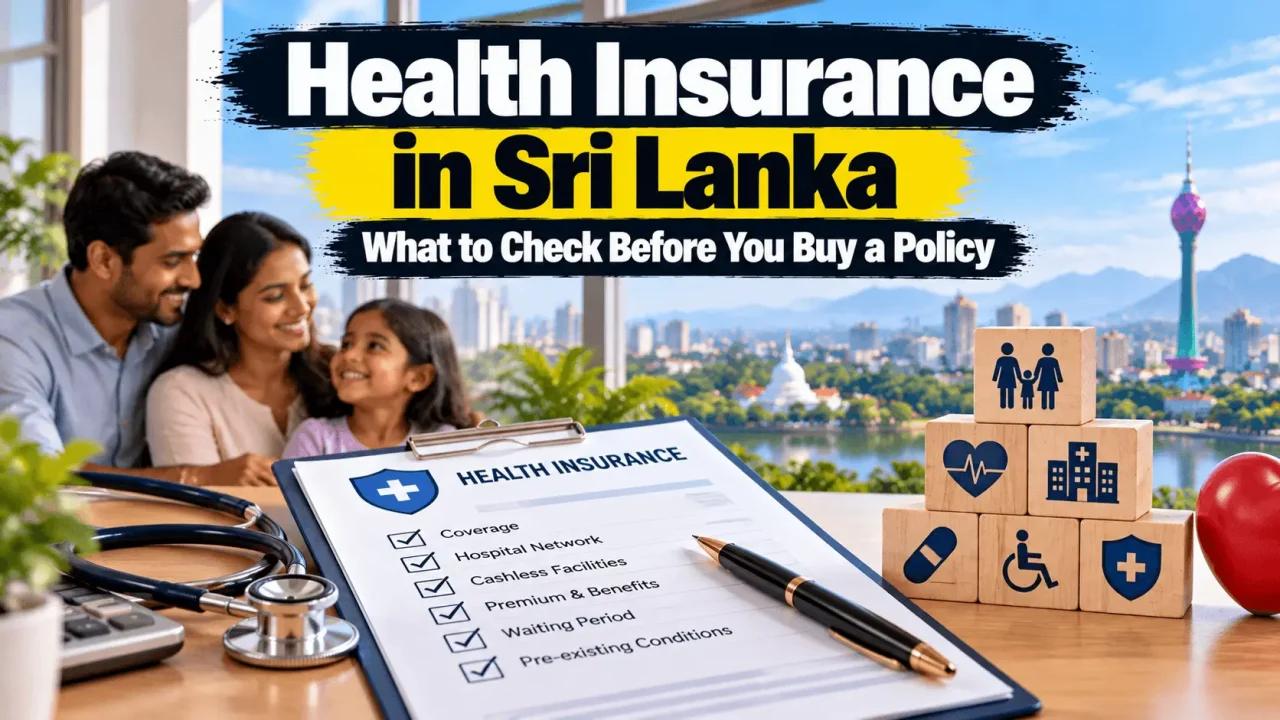
Health Insurance Sri Lanka: Quick Checklist
Before buying a policy, check these first:
| Question | Why It Matters |
|---|---|
| What is the annual medical limit? | This is the maximum available during the policy year |
| Is the limit individual or shared by the family? | One large family claim could consume a shared limit |
| Are there sub-limits? | Surgery, room, maternity, implants and other items may have separate caps |
| What are the waiting periods? | Some illnesses may not be covered immediately |
| Are pre-existing conditions covered? | They may be excluded, loaded or covered only under certain conditions |
| Is treatment cashless? | You may otherwise need to pay first and claim later |
| Which hospitals are in the cashless network? | Cashless cover may not work at every hospital |
| Is outpatient treatment covered? | Many plans mainly cover hospitalisation |
| Are day-care surgeries covered? | Modern procedures may not require an overnight stay |
| Is maternity included? | It is often optional and subject to a long waiting period |
| What is the maximum entry age? | Waiting until later can reduce your choices |
| Until what age can cover continue? | Entry age and cover-ceasing age are different |
| Is there a deductible or co-payment? | You may have to pay part of every claim yourself |
| Does it cover treatment overseas? | Geographical limits vary |
| Is it standalone health insurance or a life-policy rider? | You may be paying for another underlying policy too |
If an insurance adviser cannot clearly answer these questions, don’t sign the proposal form yet.
First: What Does Health Insurance Actually Do?
Health insurance is designed to protect you against some or all of the financial cost of covered medical treatment.
Depending on the policy, benefits can include:
- Private hospital bills
- Surgery
- Consultant fees
- Theatre charges
- ICU expenses
- Investigations
- Medicines during hospitalisation
- Day-care procedures
- Ambulance costs
- Pre- and post-hospitalisation treatment
- Maternity
- Government hospital cash allowances
- Overseas medical treatment
- Dental or optical benefits
- Critical illness benefits
But there is no single standard Sri Lankan health policy containing all of these benefits.
The Insurance Regulatory Commission of Sri Lanka itself advises consumers to examine the benefits, limitations, exclusions and claim requirements in the actual policy document before purchasing.
You can also verify whether an insurance company is currently licensed through the regulator’s official list. IRCSL – Licensed Insurance Companies
Health Insurance Is Not the Same as Life Insurance
This distinction matters because some Sri Lankan medical covers are sold as:
standalone medical insurance
while others are:
health benefits attached to a life insurance policy.
Standalone Health Insurance
The main purpose is paying eligible medical expenses.
For example, a general insurer may issue an annual medical-expense policy.
Health Rider / Optional Benefit Attached to Life Insurance
You first hold a life insurance policy and add hospitalisation or health protection to it.
For example, AIA describes Health Passport as an additional health benefit available with qualifying AIA life products.
Union Health 360 is similarly offered as an optional health benefit attached to eligible Union Assurance life insurance plans.
Why Does This Matter?
Imagine two quotes:
Policy A
Medical cover: Rs. 5 million
Annual cost: Rs. 80,000
Policy B
Medical rider: Rs. 5 million
Medical rider cost: Rs. 55,000
Policy B appears cheaper.
But if you must also maintain a life policy costing another Rs. 60,000 annually, the comparison changes.
Always ask:
“Is this medical cover available by itself, or do I need another life insurance policy to obtain it?”
Compare the complete annual premium, not only the health rider.
Hospital Expense Insurance vs Hospital Cash
These are not the same product.
Hospital Expense Cover
This reimburses eligible actual medical expenses.
Example:
Eligible hospital bill:
Rs. 800,000
Subject to your policy limits and conditions, the insurer may reimburse or settle the eligible amount.
Hospital Cash Cover
This pays a predefined amount for each day you’re hospitalised.
Example:
Hospital cash benefit:
Rs. 5,000 per day
Hospital stay:
5 days
Benefit:
Rs. 25,000
Your actual hospital bill might be:
Rs. 600,000
The policy still pays the fixed cash benefit according to its schedule.
Hospital cash can be useful for:
- Lost income
- Transport
- Food
- Family expenses
- Non-medical costs
but it isn’t the same thing as comprehensive hospital-expense insurance.
If your main concern is a Rs. 1 million private hospital bill, don’t accidentally buy only a Rs. 5,000-per-day hospital cash plan.
Critical Illness Insurance Is Different Again
Critical illness insurance usually pays a lump sum when you meet the policy definition for a covered condition.
Examples can include specified:
- Cancer
- Heart attack
- Stroke
- Major organ conditions
depending on the policy.
Suppose your critical-illness benefit is:
Rs. 5 million
and you meet the exact policy definition of a covered illness.
The insurer may pay the Rs. 5 million lump sum regardless of whether your immediate hospital bill was Rs. 1 million or Rs. 3 million.
That money can potentially help with:
- Treatment
- Income replacement
- Loan repayments
- Travel
- Long-term recovery costs
Hospital expense insurance and critical illness insurance therefore solve different financial problems.
Don’t assume one automatically includes the other.
How Much Health Insurance Cover Do You Need?
There is no single correct figure.
But ask yourself:
What kind of medical bill would seriously damage our family’s finances?
If you have:
Rs. 2 million emergency savings
and can comfortably absorb a Rs. 100,000 medical expense, you may not need insurance designed mainly around very small bills.
The bigger concern might be:
Rs. 1 million–5 million+ hospitalisation
that could consume years of savings.
Insurance is generally most valuable for risks that are:
unlikely but financially painful.
That’s why it can make more sense to combine:
- A reasonable deductible
- Strong catastrophic hospital cover
- Your own emergency savings
rather than paying a very high premium simply to insure every Rs. 5,000 or Rs. 10,000 medical expense.
Peak Lanka’s guide on How Much Emergency Savings Do You Need in Sri Lanka? explains why insurance and emergency savings should work together rather than replace each other.
Rs. 1 Million Cover Isn’t What It Used to Be
When choosing the sum insured, think about future medical inflation, not only today’s hospital charges.
A Rs. 1 million medical limit can sound substantial.
But one significant:
- Surgery
- ICU admission
- Cancer treatment
- Cardiac procedure
- Complicated hospitalisation
can potentially consume a large part of that limit.
And if you’re buying a policy you hope to maintain for the next 20 or 30 years, medical costs are unlikely to remain at today’s levels.
Look for whether the product allows:
- Higher benefit levels
- Regular upgrades
- No-claim increases
- Reinstatement of exhausted cover
rather than permanently locking yourself into a small amount.
Annual Limit vs Lifetime Limit
Ask exactly what the quoted limit means.
Suppose your policy says:
Rs. 5 million
Does that mean:
Rs. 5m every policy year?
or:
Rs. 5m maximum over the entire policy?
or:
Rs. 5m family limit shared by everyone?
or:
Rs. 5m overall but only Rs. 500,000 for a particular treatment?
Those are completely different policies.
The phrase:
“Up to Rs. 5 million cover”
isn’t enough.
Ask for the benefit schedule.
Watch for Sub-Limits
A policy can advertise a large overall limit but still restrict individual expenses.
Possible sub-limits include:
- Room charges
- ICU
- Maternity
- Cataract surgery
- Implants
- Ambulance
- Dental
- Optical
- Ayurvedic treatment
- Prostheses
- Organ donor expenses
- Pre/post hospitalisation
- Government hospital allowance
For example, AIA’s current Health Passport structure has separate limits for benefits such as ambulance charges, implants, pre/post hospitalisation and other categories even though the overall health benefit can be much larger.
This isn’t necessarily bad.
Sub-limits help insurers price policies.
The important thing is knowing they exist before you need to claim.
Check the Room-Rent Limit Carefully
This sounds like a minor detail.
It isn’t.
Suppose your policy allows:
Standard private room
but you choose:
Premium suite
Some policies may limit only the room reimbursement.
Others can reduce additional hospital expenses because those charges are linked to the room category.
Policies differ.
AIA’s overseas-treatment terms, for example, specifically contain a reduced-payment rule when the insured chooses a room category above the permitted category.
Before buying, ask:
“What room category am I entitled to?”
and:
“If I choose a more expensive room, does the reduction apply only to room rent or to the entire eligible hospital bill?”
Get the answer from the policy document.
Cashless Health Insurance: What Does “Cashless” Really Mean?
Cashless hospitalisation is one of the most useful health-insurance features.
Instead of:
- Paying Rs. 800,000 yourself.
- Collecting documents.
- Submitting a reimbursement claim.
- Waiting for settlement.
the insurer can settle the approved eligible amount directly with the hospital.
Current products from insurers including AIA, Union Assurance and Sri Lanka Insurance advertise cashless hospitalisation facilities.
But:
cashless does not necessarily mean “walk out without paying anything.”
You can still need to pay:
- Deductible
- Co-payment
- Excluded expenses
- Charges above a sub-limit
- Non-medical items
- Room-category difference
- Treatments not approved
- Amount above the annual limit
And cashless treatment may depend on using an approved hospital.
Check the Hospital Network Before You Buy
Don’t ask only:
“Do you have cashless hospitals?”
Ask:
“Which hospitals can I actually use?”
Consider where you and your family normally receive treatment.
If you live outside Colombo, a policy with an impressive Colombo hospital network but poor access near you may be less useful.
Check:
- Hospitals near home
- Hospitals near work
- Major Colombo hospitals
- Specialist hospitals
- Children’s hospitals
- Hospitals you would realistically use in an emergency
AIA, for example, maintains a separate approved hospital network for cashless facilities. AIA Cashless Hospital Network
Networks can change.
Check the latest list rather than relying on what an adviser remembers.
Reimbursement vs Cashless
Even a policy offering cashless treatment may still use reimbursement in some situations.
Cashless
Insurer settles eligible costs directly with the approved hospital.
Reimbursement
You pay the hospital first.
Then submit:
- Bills
- Receipts
- Diagnosis
- Medical reports
- Claim form
- Prescriptions
- Other requested documents
to recover the eligible amount.
If you don’t have enough emergency savings to temporarily pay a large hospital bill, the cashless network becomes especially important.
Waiting Periods Can Completely Change a Policy
One of the biggest mistakes is buying health insurance today and assuming every illness is covered tomorrow.
Many policies have waiting periods.
Current Sri Lankan products demonstrate how different these can be.
AIA Health Passport
Current AIA information lists:
- General illness waiting period: 90 days
- Certain common surgical conditions: 1 year
- Dental: 180 days
- Maternity: 24 months
Accident-related treatment can be treated differently.
Union Health 360
Current specimen wording provides a general waiting period of:
90 days
and a longer:
365-day
period for several specified conditions and surgeries.
Maternity has a separate waiting period under the policy.
Fairfirst Personal Health
The currently published product information lists:
- General illness: 30 days
- Critical illnesses: 6 months
- Specified ailments: 6 months
- Maternity: 12 months
This is why you cannot compare policies using only:
Annual premium + maximum cover.
Waiting periods matter.
Maternity Cover: Buy Before You Need It
If maternity is important to you, check it before pregnancy.
Many policies contain a long maternity waiting period.
Current examples include:
12 months
and:
24 months
depending on the policy.
Some maternity benefits may also have:
- Separate benefit limits
- Entry-age restrictions
- Maximum number of covered deliveries
- Caesarean limits
- Newborn conditions
- Miscarriage conditions
For example, AIA’s current maternity option applies only within specified entry ages and benefit plans and is subject to policy conditions.
So:
“We’ll buy insurance after we find out we’re expecting a baby.”
may be too late for maternity expenses under many policies.
What About Pre-Existing Conditions?
A pre-existing condition is generally a health condition that existed before the insurance policy began.
Examples could include a condition that had already been:
- Diagnosed
- Treated
- Investigated
- Medicated
- Symptomatic
depending on the policy definition.
What happens to it varies enormously.
An insurer might:
- Exclude it permanently
- Apply a waiting period
- Charge a higher premium
- Apply special conditions
- Cover it subject to limits
- Decline the application
The IRCSL’s health-insurance guidance specifically notes that pre-existing conditions may be treated differently depending on the policy and can sometimes be considered after waiting periods.
Never Hide a Medical Condition to Get a Cheaper Policy
This is important.
Suppose the proposal form asks:
“Have you ever been treated for hypertension?”
and the truthful answer is yes.
Don’t tick:
No
because an insurance adviser casually says:
“Don’t worry, just leave it out.”
Material non-disclosure can create major problems when you later make a claim.
The regulator’s general insurance guidance advises customers to fully disclose material facts when purchasing insurance.
If you’re unsure whether something should be declared:
declare it and ask the insurer to decide.
A written exclusion you understand today is better than discovering during a Rs. 2 million hospital claim that the insurer believes material medical information wasn’t disclosed.
“No Medical Test Required” Does Not Mean “No Medical Disclosure”
These are different things.
For example, Sri Lanka Insurance currently says Medi Plus does not require medical reports up to a specified age.
That doesn’t mean a customer can omit known medical history from the proposal.
Medical underwriting can involve:
- Proposal-form answers
- Medical records
- Medical examination
- Blood tests
- Specialist reports
depending on the applicant and insurer.
A plan marketed as:
“No medical test”
is not automatically:
“Every existing disease is covered.”
Some Policies Exclude Pre-Existing Conditions Entirely
Fairfirst’s currently published Personal Health Insurance information, for example, lists pre-existing conditions among its exclusions.
At the same time, other products may make different provisions.
Sri Lanka Insurance’s Medi 60 senior-citizen product says pre-existing conditions are generally excluded except for specified conditions such as diabetes, cholesterol and hypertension, subject to the product terms.
This illustrates why you should never ask:
“Does health insurance in Sri Lanka cover diabetes?”
as though there is one industry-wide answer.
The answer depends on the exact policy.
Check the Maximum Entry Age
This is a major reason not to postpone health-insurance research until retirement.
Current products illustrate how entry limits work.
AIA Health Passport
Adult entry:
approximately 19–61
Cover can continue up to around:
70
subject to the policy.
Sri Lanka Insurance Medi Plus
Adult entry:
18–60
Cover ceases around:
69.
Union Health 360
Current entry age:
18–65.
Sri Lanka Insurance Medi 60
A dedicated senior product allowing entry between:
60–70
with cover continuing up to:
80.
These aren’t directly comparable products.
The point is:
Entry age matters.
Waiting until 65 to start looking can significantly reduce your choices.
Maximum Entry Age Is NOT the Same as Renewal Age
Suppose a policy says:
Maximum entry age: 60
That doesn’t necessarily mean your policy ends the day you turn 61.
It could allow existing policyholders to continue until:
- 65
- 69
- 70
- 80
or another specified age.
So ask two separate questions:
1. What is the maximum age to join?
2. Until what age can I keep renewing the cover?
The second question is especially important if you’re buying health insurance as part of retirement planning.
Healthcare can become more important after 60, not less.
Peak Lanka’s How Much Money Do You Need to Retire in Sri Lanka? explains why medical expenses should be included in a long-term retirement budget.
Don’t Rely Only on Employer Health Insurance
Employer medical insurance is valuable.
If your employer already gives your family:
Rs. 500,000
or:
Rs. 1 million
of annual medical cover, buying another identical plan may not be your first priority.
But ask:
What happens if I resign?
What happens if I’m retrenched?
What happens when I retire?
Can I continue the policy personally?
How much is the family limit?
Does it cover my spouse and children?
Does it cover my parents?
Employer medical cover commonly ends when employment ends.
AIA itself highlights this issue when explaining why someone with company medical insurance may still consider personal cover.
Employer Cover + Personal Cover Can Work Together
Suppose your employer gives:
Rs. 500,000 medical cover
and you want protection against much larger bills.
Instead of buying an expensive personal policy that covers everything from the first rupee, you could compare plans with a:
deductible / self-pay amount.
For example:
You pay the first:
Rs. 50,000
or:
Rs. 100,000
and insurance covers eligible expenses above that amount.
AIA, for example, currently offers self-pay options where the insured bears the first Rs. 50,000 or Rs. 100,000 of eligible claims in exchange for a premium discount.
Union Health 360 similarly markets cost-sharing options that can reduce premiums.
This can make sense for people who already have:
- Employer insurance
- Strong emergency savings
and mainly want protection against larger medical costs.
What Is a Deductible?
A deductible is the amount you pay before insurance starts paying the eligible claim.
Example:
Hospital bill:
Rs. 700,000
Eligible bill after exclusions:
Rs. 650,000
Deductible:
Rs. 100,000
Insurance pays:
Rs. 550,000
You pay at least:
Rs. 100,000
plus any excluded charges.
The advantage is usually a lower premium.
The disadvantage is that you need enough savings to pay the deductible when something happens.
What Is a Co-Payment?
A co-payment means you share a percentage of the eligible bill.
Suppose:
Eligible claim:
Rs. 1,000,000
Co-payment:
20%
You pay:
Rs. 200,000
Insurer pays:
Rs. 800,000
Again:
Rs. 1 million cover
doesn’t automatically mean the insurer pays Rs. 1 million of every claim.
Ask specifically:
“Is there any co-pay percentage?”
Family Floater vs Individual Cover
Some insurers let families choose between:
one shared family limit
and:
separate individual limits.
Family Floater Example
Family of four:
Annual shared cover:
Rs. 5 million
If one parent has a major claim of:
Rs. 4 million
only:
Rs. 1 million
may remain for everyone else that year, unless the policy provides a restoration benefit.
Individual Cover Example
Parent 1:
Rs. 2m
Parent 2:
Rs. 2m
Child 1:
Rs. 1m
Child 2:
Rs. 1m
One person’s claim doesn’t necessarily consume another person’s limit.
But individual cover can cost more.
AIA currently allows family members to be covered either under a shared family amount or individual amounts, subject to its product rules.
Union Health 360 also offers family-unit arrangements where the overall annual family limit is shared among covered family members.
Neither structure is universally better.
A young healthy family may find a floater cost-effective.
A family with an older parent or higher medical risk may prefer stronger individual limits.
What Is a Reinstatement / Restoration Benefit?
Suppose you buy:
Rs. 5 million annual cover.
Then you experience a major hospitalisation and use the whole Rs. 5 million.
What happens if another serious event occurs three months later?
Some policies offer a reinstatement or restoration benefit.
For example, AIA currently provides an additional benefit amount after full exhaustion for a subsequent hospitalisation subject to conditions, including that it is not related to preceding causes.
Union Health 360 also advertises additional cover after the annual benefit has been exhausted for another unrelated medical emergency, subject to its policy terms.
This feature can be valuable.
But check:
- Does restoration apply once or multiple times?
- Must the second condition be unrelated?
- Can the restored amount cover the same insured person?
- Does unused restoration carry into next year?
Don’t assume the word “restore” means unlimited medical cover.
Check Day-Care Surgery Coverage
Older insurance policies often centred around:
hospitalisation for at least 24 hours.
Modern medicine has changed that.
Some operations and procedures can now be completed without an overnight admission.
That’s why day-care coverage matters.
AIA currently lists 136 day-care treatments/surgeries under Health Passport.
Sri Lanka Insurance Medi Plus also advertises day-care surgery benefits.
Ask for the actual list.
Don’t assume:
“Any surgery taking less than 24 hours is automatically covered.”
It may need to be one of the listed procedures or meet the policy definition.
What About Outpatient Treatment?
This is another area where buyers often assume too much.
A comprehensive hospitalisation plan does not necessarily cover ordinary:
- GP consultations
- Specialist consultations
- Monthly medicine
- Routine blood tests
- Physiotherapy
- Dental cleaning
- Spectacles
unless the policy specifically includes those benefits.
Some policies cover outpatient costs only when they are directly connected to a covered hospitalisation.
For example, AIA Health Passport’s current pre/post hospitalisation benefit can cover qualifying related expenses incurred within specified periods around hospitalisation.
That’s different from:
“All my doctor visits are free.”
Check Pre- and Post-Hospitalisation Cover
A hospital bill isn’t always the entire medical expense.
Before admission you may need:
- Consultant visit
- MRI
- CT scan
- Blood tests
- Medication
After discharge:
- Follow-up visits
- Dressings
- Medication
- Investigations
- Rehabilitation
A policy offering pre/post hospitalisation cover can help with those expenses.
But check:
- Number of days before admission
- Number of days after discharge
- Percentage/sub-limit
- Whether the expense must directly relate to the covered diagnosis
AIA currently uses a 30-day period before and after hospitalisation for its applicable benefit.
Other policies can use different periods.
Check Maternity Separately
Even policies saying:
“Maternity available”
can differ dramatically.
Ask:
- Normal delivery limit?
- Caesarean limit?
- Waiting period?
- Maximum number of pregnancies?
- Miscarriage cover?
- Pregnancy complications?
- Newborn expenses?
- Baby automatically insured?
- Entry age for maternity?
- Is maternity optional or included?
Never buy a policy because the brochure simply says:
“Maternity covered.”
Get the benefit table.
What About Parents and Senior Citizens?
Covering parents is where health insurance becomes significantly more complicated.
Premiums usually rise with age.
Pre-existing health conditions become more common.
Entry-age restrictions become important.
Some modern family plans allow parents to be included.
AIA and Union Health 360, for example, currently advertise family structures that can include parents, subject to their eligibility and underwriting rules.
There are also dedicated senior plans such as Sri Lanka Insurance Medi 60.
But don’t automatically assume:
family plan = parents receive identical terms to a 30-year-old child.
Check underwriting and limits for every covered person.
How Much Does Health Insurance Cost in Sri Lanka?
There isn’t one meaningful universal price.
Premium can depend on:
- Age
- Number of people covered
- Medical history
- Sum insured
- Geographical coverage
- Maternity
- Deductible
- Co-payment
- Optional benefits
- Policy type
- Claim history
- Underwriting outcome
The IRCSL’s consumer guidance also identifies age, family health circumstances and claim experience among factors that can influence health-insurance premiums.
This is why a website saying:
“Best health insurance – only Rs. X per month”
isn’t necessarily useful.
The price offered to a healthy 25-year-old can be very different from the price offered to a 55-year-old.
How Should You Compare Premiums?
Ask three insurers for the same scenario.
For example:
Age: 35
Spouse: 34
One child: 5
Sri Lanka-only cover
Rs. 5 million annual family medical cover
No maternity
Rs. 50,000 deductible
Cashless private hospital cover
Then compare the responses.
If one insurer quotes:
Rs. 60,000
and another:
Rs. 90,000
you can start examining why.
Maybe the second policy includes:
- More hospitals
- Better room entitlement
- Lower waiting periods
- Worldwide cover
- Stronger restoration
- Fewer sub-limits
or maybe it’s simply more expensive.
You need the benefit schedule to know.
Compare the Premium at Age 50 — Not Only Today
This question is underappreciated:
“How will my premium change as I get older?”
You might comfortably afford:
Rs. 50,000 per year
at age 30.
But what happens at:
40?
50?
60?
Ask whether premiums are:
- Age-banded
- Reviewable annually
- Affected by claims
- Affected by medical inflation
- Guaranteed only for a certain period
Health insurance is much more useful if you can afford to maintain it when you’re older.
No-Claim Bonus Can Increase Your Cover
Some policies reward claim-free years.
Sri Lanka Insurance Medi Plus currently increases the basic sum insured by 5% for each claim-free year, up to a maximum increase of 50%.
AIA Health Passport currently provides a 25% annual no-claim increase under applicable plans, up to the specified maximum.
Union Health 360 similarly advertises a 25% increase for each claim-free year, allowing the benefit to potentially double after four claim-free years.
This can partially help your coverage keep pace over time.
But ask what happens after you make a claim.
The bonus may:
- Reduce
- Reset
- Remain
- Follow another formula
depending on the product.
Sri Lanka-Only vs Worldwide Health Insurance
If you expect all treatment to happen in Sri Lanka, worldwide cover may add unnecessary cost.
But global medical cover can be valuable for people who:
- Travel frequently
- Live between countries
- Want treatment in Singapore or India
- Have children overseas
- Want access to specialised international care
AIA currently offers worldwide benefits excluding the USA and Canada on qualifying higher Health Passport plans.
Union Health 360 also advertises worldwide coverage excluding the USA and Canada.
But overseas treatment can involve:
- Prior approval
- Geographical restrictions
- Different room limits
- Reimbursement instead of cashless service
- Emergency-notification deadlines
Don’t interpret:
“Worldwide cover”
as:
“I can fly anywhere tomorrow and send them the bill.”
International Health Insurance Is Another Category
People wanting very high international medical cover can also access foreign health-insurance products through authorised Sri Lankan brokers.
IRCSL maintains a specific list of brokers authorised to place foreign health products such as approved Bupa and Allianz Care products during their authorised periods.
These can be relevant to:
- Expats
- High-net-worth families
- Internationally mobile professionals
- People requiring extensive overseas medical access
But they are a different category from normal domestic health insurance and can cost considerably more.
Verify that the broker and product are currently authorised by IRCSL.
Should You Choose the Policy With the Highest Claim Settlement Ratio?
Claim-settlement statistics can be useful.
IRCSL publishes insurer claim-settlement information for consumers.
But don’t reduce your entire decision to:
Company A = 95%
Company B = 90%
therefore:
Company A must be better.
Claim statistics can be affected by:
- Product mix
- Types of claims
- Claim values
- Number of cases
- Validity of submitted claims
And a high claim-settlement ratio does not change an exclusion written clearly into your own policy.
Use claim statistics as one input, not the entire decision.
Read the Policy Document — Not Only the Brochure
The colourful brochure tells you:
Up to Rs. 10 million cover
Cashless hospitalisation
Worldwide protection
The policy document tells you:
when they don’t have to pay.
That makes the policy document more important.
IRCSL explicitly advises consumers to obtain and understand the policy wording, including limitations and exclusions.
Ask for:
specimen policy wording
before purchasing.
If an adviser says:
“Don’t worry about all that; everything is covered.”
don’t rely on the verbal statement.
Ask them to show you the relevant section of the policy.
Current Sri Lankan Health Plans: Examples, Not Rankings
The following table demonstrates how different current products can be.
It is not a ranking and doesn’t compare every benefit or insurer.
| Current Product | Some Published Features |
|---|---|
| AIA Health Passport | Rs.250k–Rs.50m benefit options; cashless/reimbursement; family options; overseas cover on qualifying plans; maternity option |
| Union Health 360 | Up to Rs.60m; individual/family structures; parents can be covered; cashless; international cover; optional maternity |
| Sri Lanka Insurance Medi Plus | Private/government hospital benefits; cashless; day-care surgery; no-claim bonus |
| Fairfirst Personal Health | Hospitalisation cover with published waiting periods and exclusions |
| Sri Lanka Insurance Medi 60 | Dedicated plan for people entering at ages 60–70 |
Sources: current insurer product information.
These products aren’t directly equivalent.
For example:
- Some are life-policy health riders.
- Some are annual general-insurance policies.
- Entry ages differ.
- Waiting periods differ.
- Pre-existing-condition treatment differs.
- International cover differs.
Get personalised quotations before comparing cost.
Is the Cheapest Policy Usually the Best?
No.
Suppose:
Policy A
Premium:
Rs. 40,000/year
Cover:
Rs. 1 million
No overseas cover
No maternity
High sub-limits
No restoration
Policy B
Premium:
Rs. 80,000/year
Cover:
Rs. 5 million
Cashless
Better room entitlement
Restoration available
Broader day-care coverage
Policy A is cheaper.
That doesn’t automatically make it better value.
The reverse is also true.
Don’t buy an expensive Rs. 20 million international policy if your actual requirement is a simple Sri Lankan hospitalisation plan.
The best policy is the one that covers your largest realistic financial risks at a premium you can sustain for many years.
Health Insurance vs Emergency Fund
You need both.
Emergency Fund
Useful for:
- Deductibles
- Excluded expenses
- Outpatient treatment
- Medicine
- Lost income
- Transport
- Short-term household costs
Health Insurance
Useful for protecting against larger covered medical expenses.
A family could therefore structure its finances like this:
Emergency savings:
Rs. 1 million
Health insurance:
Rs. 5 million+
rather than trying to self-insure every possible Rs. 5 million hospital event using cash.
The correct figures depend on your household.
Read Peak Lanka’s How Much Emergency Savings Do You Need in Sri Lanka? for the emergency-fund side of the calculation.
Health Insurance and Your Family Budget
Insurance is useful only if you can continue paying for it.
If your household spends nearly every rupee of income each month, committing to a very expensive policy that lapses after two years may not provide the protection you expected.
Build the premium into your real family budget.
Peak Lanka’s How Much Salary Do You Need to Live Comfortably in Sri Lanka in 2026? includes healthcare and insurance as part of a sustainable household budget rather than treating them as optional leftovers.
Parents should also consider healthcare alongside the longer-term costs explained in How Much Does It Actually Cost to Raise a Child in Sri Lanka?.
Does Health Insurance Premium Reduce Your Income Tax in 2026?
Be careful with old Sri Lankan articles.
You can still find older material online referring to a broad personal expenditure relief that included health expenditure and medical-insurance contributions.
That was under an earlier tax regime.
For Y/A 2025/2026, the IRD’s current tax chart lists the Rs. 1.8 million personal relief and specific current reliefs such as applicable rent and solar-panel relief, but does not list a general individual relief for health-insurance premiums.
So don’t buy a health-insurance policy in 2026 assuming:
“I can deduct the entire premium from my taxable income.”
If tax treatment is material to your decision, check the latest IRD rules or obtain tax advice.
What Happens If the Insurer Rejects Your Claim?
First, ask for the decision in writing.
Then compare the reason against:
- Policy wording
- Exclusions
- Benefit schedule
- Proposal form
- Medical disclosure
- Claim documents
If you disagree, follow the insurer’s internal complaint process first.
IRCSL says dissatisfied policyholders should:
Step 1: complain to the insurance company.
If the matter isn’t resolved satisfactorily:
Step 2: escalate to the Insurance Regulatory Commission of Sri Lanka or the Insurance Ombudsman.
The Insurance Ombudsman service covers issues including non-settlement, delayed claims and disputes about interpretation of policy terms. Insurance Ombudsman Sri Lanka
The IRCSL also publishes each insurer’s complaints-handling procedure. IRCSL Insurance Company Complaints Procedures
Don’t Throw Away Your Proposal Form
Keep copies of:
- Proposal form
- Medical declarations
- Policy schedule
- Benefit table
- Policy wording
- Premium receipts
- Adviser correspondence
- Medical reports submitted during underwriting
Why?
Imagine a claim five years later where the insurer says:
“This condition wasn’t disclosed.”
Having a copy of what you actually declared can become extremely important.
Don’t allow the adviser to fill the medical section without you reviewing every answer.
20 Questions to Ask Before Buying Health Insurance
Take this checklist to the insurance adviser.
Coverage
- What is the annual overall limit?
- Is the limit per person or shared by the family?
- Are there any lifetime limits?
- What are the main sub-limits?
- Which day-care procedures are covered?
Hospital
- Which hospitals provide cashless treatment?
- What room category am I allowed?
- What happens if I choose a more expensive room?
- Are ICU charges separately limited?
- Do I need pre-authorisation?
Medical Conditions
- What is the general waiting period?
- Which conditions have longer waiting periods?
- How are my existing medical conditions treated?
- Are congenital conditions excluded?
- Is outpatient treatment covered?
Family
- Is maternity included and what is its waiting period?
- Can my spouse, children and parents be included?
- Is the family benefit shared or individual?
Long-Term
- What is the maximum renewal/cover-ceasing age?
- How can the premium change as I get older?
And I would add one more:
“Please give me the actual policy wording before I sign.”
Health Insurance Sri Lanka FAQ
Is health insurance worth it in Sri Lanka?
It can be valuable if a large private medical bill would seriously damage your savings.
Sri Lanka’s public healthcare system provides an important alternative, so the value of private insurance depends on how strongly you want access to private treatment, choice, convenience and financial protection.
What is the best health insurance in Sri Lanka?
There is no universally best policy.
The right plan depends on:
- Age
- Family
- Medical history
- Budget
- Required cover
- Hospitals
- Maternity needs
- Overseas treatment
- Existing employer insurance
Compare policy wording rather than brand names alone.
How much health insurance should I have?
There is no standard amount.
Consider what size of hospital expense your emergency savings cannot comfortably absorb.
For many households, the purpose of insurance should be protecting against large medical costs rather than reimbursing every small expense.
Can I get Rs. 10 million or more of cover?
Yes.
Several current Sri Lankan health products offer multi-million-rupee benefit options.
For example, AIA advertises options up to Rs. 50 million and Union Health 360 up to Rs. 60 million, subject to eligibility and policy conditions.
Can I cover my whole family?
Yes, several products allow spouse and children, while some also allow parents.
Check whether the benefit is a shared family floater or individual limit.
Can I cover my parents?
Some policies allow parents to be included.
Entry age, medical underwriting and pre-existing conditions become particularly important for older parents.
Can I buy health insurance after age 60?
There are options, but choices become more limited.
Some mainstream products stop accepting new adults around age 60–65, while dedicated senior products can allow later entry.
Can a 70-year-old get health insurance?
Certain senior products may allow cover around this age, subject to entry rules and underwriting.
Sri Lanka Insurance Medi 60, for example, currently allows entry from age 60 to 70 and cover up to age 80.
Are pre-existing conditions covered?
It depends completely on the policy.
They may be:
- Excluded
- Covered after waiting
- Subject to special conditions
- Covered with additional premium
- Declined
Never assume.
Should I disclose diabetes, hypertension or cholesterol?
Yes, answer proposal-form medical questions truthfully.
Let the insurer decide what terms apply.
Does health insurance cover maternity?
Some policies offer maternity.
Waiting periods are common and can be 12–24 months or another period depending on the plan.
Can I buy maternity insurance after becoming pregnant?
A policy’s waiting period can make a new pregnancy ineligible.
Check the exact wording before relying on maternity cover.
Does health insurance cover normal doctor visits?
Not necessarily.
Many policies focus mainly on hospitalisation.
Routine outpatient consultations and medicine may be excluded unless specifically included.
Does health insurance cover dental?
Some policies offer limited dental benefits.
Others exclude routine dental treatment.
Check the benefit schedule.
Does health insurance cover spectacles?
Usually not automatically.
Some products provide optional or limited optical benefits.
Does health insurance cover cancer?
Many comprehensive plans provide hospitalisation for eligible cancer treatment, while separate critical-illness plans may pay lump sums.
Definitions, limits and exclusions vary.
Does health insurance cover government hospitals?
Some policies provide:
- Daily cash benefit
- Drugs/tests purchased externally
- Other specified benefits
for government hospital admissions.
AIA, Sri Lanka Insurance and other insurers offer variations of this type of benefit.
Is cashless insurance better?
Cashless treatment can be much more convenient because you don’t need to fund the entire eligible hospital bill yourself first.
But check the hospital network and pre-authorisation procedure.
Does cashless mean I pay nothing?
No.
You may still pay deductibles, co-payments, excluded expenses and charges exceeding policy limits.
Can I use health insurance overseas?
Some plans provide overseas treatment.
The geographical area, approval requirements and benefit amounts vary.
Does worldwide health insurance include the USA?
Not always.
Several Sri Lankan products advertising worldwide treatment explicitly exclude the USA and Canada.
Can I have employer insurance and personal insurance?
Yes.
Having employer medical insurance doesn’t necessarily prevent you from holding additional personal cover.
Check how coordination/deductibles work between the two policies.
What happens to my company insurance when I resign?
Employer-provided insurance normally depends on employment.
Don’t assume it remains yours after leaving the company.
Check your employer’s scheme.
Will my health insurance premium increase every year?
It can.
Age, claims, insurer pricing, medical inflation and policy terms can affect renewal premiums.
Ask for the premium structure before purchasing.
Can an insurer reject my claim?
A claim can be rejected where it falls outside policy coverage or violates applicable terms.
If you disagree, first use the insurer’s complaints process and then consider IRCSL or the Insurance Ombudsman.
Who regulates insurance companies in Sri Lanka?
The Insurance Regulatory Commission of Sri Lanka (IRCSL) regulates licensed insurers. Insurance Regulatory Commission of Sri Lanka
Official Resources
Before purchasing health insurance, check:
IRCSL Licensed Insurance Companies
IRCSL Health Insurance Consumer Guidance
IRCSL Policyholder Complaints Information
If you’re purchasing an international product through a broker:
IRCSL Authorised Brokers for Foreign Health Insurance Products
A Practical Way to Compare Three Policies
Don’t give each adviser a different request.
Give all three exactly the same requirements.
For example:
Family
Two adults + one child
Cover
Rs. 5 million annual medical cover
Geography
Sri Lanka
Hospital
Cashless private hospital treatment
Maternity
Not required
Deductible
Ask for both zero-deductible and Rs. 50,000 options
Then create a table:
| Feature | Policy A | Policy B | Policy C |
|---|---|---|---|
| Annual premium | |||
| Total annual cover | |||
| Family/shared or individual | |||
| Room limit | |||
| General waiting period | |||
| Pre-existing conditions | |||
| Cashless hospitals | |||
| Day-care surgeries | |||
| Pre/post hospitalisation | |||
| Deductible | |||
| Co-pay | |||
| Restoration | |||
| No-claim increase | |||
| Maximum renewal age | |||
| Overseas cover |
Once this table is complete, the cheapest policy may still win.
But at least you’ll know why it is cheaper.
So, What Should You Check Before Buying Health Insurance?
Don’t start with:
“Which insurance company is best?”
Start with:
“What medical risk am I trying to protect my family from?”
Then check:
Annual cover
Sub-limits
Waiting periods
Pre-existing conditions
Cashless hospitals
Room entitlement
Deductibles and co-payments
Maternity
Family structure
Entry and renewal age
Premium affordability
Actual policy exclusions
A health insurance policy isn’t good because it has the biggest number on the brochure.
It is good if, when you actually need medical treatment five or ten years from now, the policy covers the risk you thought you had insured — and you can still afford to keep the policy active.
Keep emergency savings alongside insurance.
Read the policy before buying.
Disclose your medical history accurately.
And compare the actual written benefits, not only what an adviser tells you verbally.
A Rs. 5 million policy you understand can be far more valuable than a Rs. 20 million policy whose exclusions you never read.
What matters most to you in a health policy — a high hospital limit, cashless claims, family cover, maternity, overseas treatment or keeping the annual premium affordable?




Questions and comments
Be the first to leave a question or comment.