
Is a University Degree Still Worth It in Sri Lanka in 2026?
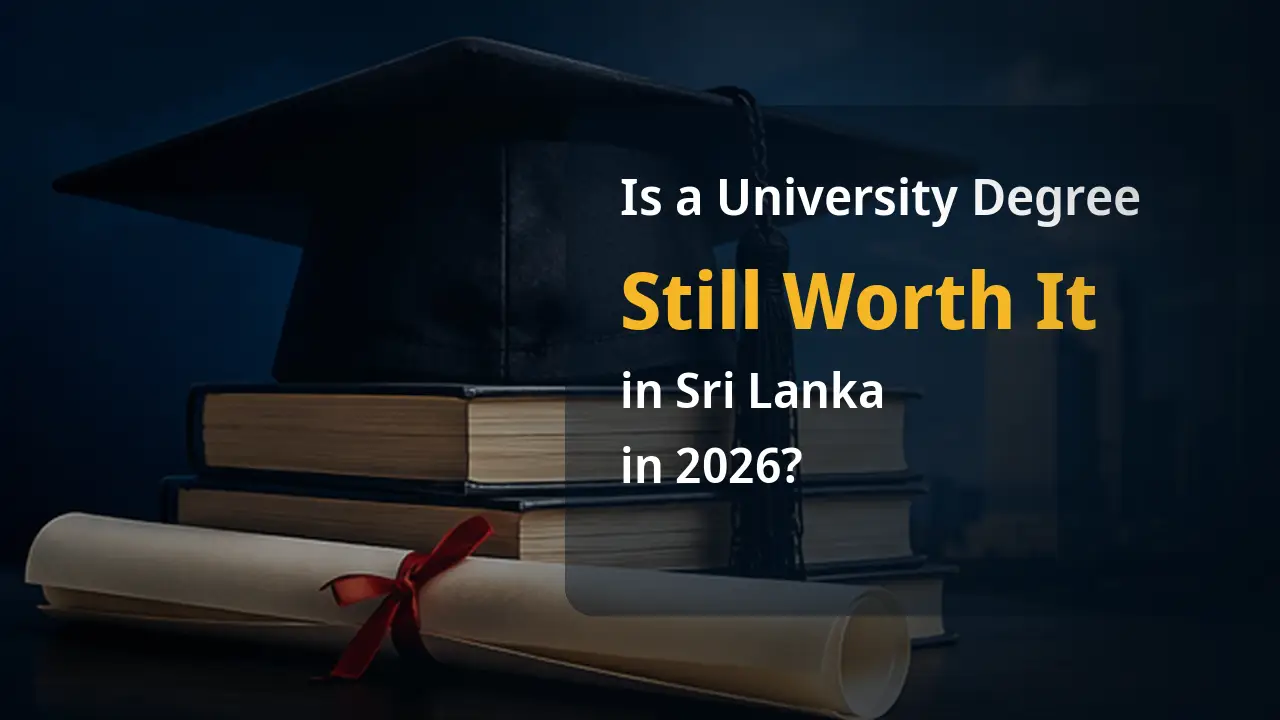
For a long time in Sri Lanka, the formula seemed simple:
Do A/Ls → get into university → get a degree → find a good job → build a stable life.
Parents still repeat this advice, and to be fair, it worked reasonably well for many people.
But in 2026, things are more complicated.
We now have graduates struggling to find suitable jobs, people without traditional degrees earning very well in technology and business, and employers increasingly talking about skills, experience and communication instead of certificates alone.
So, is spending three or four years on a university degree still worth it?
Yes — but a degree is no longer enough by itself.
And depending on the career you want, it may not even be the best path.
First, a Degree Still Has Real Value
It would be misleading to say, “Degrees are useless now.”
They aren’t.
There are careers where a recognised university qualification is either compulsory or practically unavoidable. Medicine is the obvious example. Many engineering, scientific, academic and specialised professional careers also have formal qualification requirements.
Even outside regulated professions, plenty of large Sri Lankan companies still use a bachelor’s degree as an initial screening requirement.
There is also an important difference between paying millions of rupees for a private degree and getting selected for Sri Lanka’s state university system.
According to the University Grants Commission, 87,776 students applied for university admission for the 2023/24 academic year, while around 42,280 were selected through the normal intake. State university education is also provided without tuition fees.
University Grants Commission – University Admissions Handbook
If you can get a respected degree without taking on a huge financial burden, the calculation is very different from spending several million rupees simply because you feel that you must have a degree.
But a Degree Does Not Guarantee Employment
This is where Sri Lanka has a problem.
The Department of Census and Statistics reported an overall unemployment rate of 3.8% in the fourth quarter of 2025, while unemployment among people with GCE A/L and above education was 5.2%.
An important clarification: “A/L and above” is not the same thing as “university graduates”, so we should not misuse this statistic and claim that degrees cause unemployment.
But it does show something interesting: having more formal education does not automatically protect someone from unemployment.
Sri Lanka Labour Force Survey – Q4 2025
The World Bank has highlighted an even bigger problem. Sri Lankan universities produce roughly 25,000–30,000 graduates each year, yet employers still report difficulty finding people with the skills they need.
Employers increasingly want practical experience, digital capability, communication, adaptability and problem-solving — things a degree certificate alone cannot prove.
World Bank – Sri Lanka’s Youth and Jobs Challenge
That gap between education and employability is probably the real issue.
The IT Industry Is a Good Example
Technology makes this particularly obvious.
SLASSCOM’s Employability Skills Survey found Sri Lankan IT companies reporting problems including shortages of suitable talent, incompatible technical skills, salary expectations and gaps in soft skills.
Some companies also reported spending considerable time and money bringing new graduates up to an employable level.
SLASSCOM Employability Skills Survey 2024
Think about what that means.
Someone can complete a four-year IT degree and still lose a job opportunity to another candidate who has:
- built several real applications,
- contributed to GitHub,
- completed an internship,
- understands modern development tools,
- communicates well in English,
- and can explain how they solved actual problems.
The degree may get your CV through the first filter.
Your skills usually have to do the rest.
The Bigger Question Is Return on Investment
Before starting a degree, particularly an expensive private one, ask a more useful question:
What exactly will this degree allow me to do that I cannot reasonably do without it?
Consider four things.
1. Cost
Tuition is not the only cost. There are registration fees, transport, accommodation, devices and other expenses.
2. Time
Three or four years is a serious investment.
Someone else might spend those years gaining practical experience, professional certifications, building a business or working their way through an industry.
3. Career requirement
If almost every serious employer in your target profession asks for the qualification, the degree probably makes sense.
If employers mainly care about your portfolio and experience, the answer becomes less obvious.
4. Quality of the degree
Not every degree has the same market value.
Having a degree and having a good degree that teaches relevant skills and provides industry exposure are two very different things.
So Who Should Definitely Consider a Degree?
A degree still makes strong sense if:
- your intended profession requires one;
- you want an academic or research career;
- reputable employers in your target industry consistently require one;
- you can enter a good state university;
- the qualification provides strong internships or industry connections;
- or you want the flexibility that a recognised qualification can provide later in your career.
But if you are entering areas such as web development, digital marketing, design, video production, sales, entrepreneurship or certain technical trades, there may be other realistic routes.
Sri Lanka also has an established National Vocational Qualifications (NVQ) framework providing structured career paths outside the conventional university route.
Tertiary and Vocational Education Commission
The Best Strategy May Be Degree + Skills
There is another mistake in this debate.
People often frame it as:
Degree vs skills.
Why not both?
If you are already doing a degree, don’t spend four years doing nothing except completing assignments and preparing for exams.
Build things.
Take internships.
Improve your English.
Learn modern tools.
Meet people in the industry.
Create a portfolio.
Try freelancing.
Understand AI tools relevant to your profession.
By graduation, you should ideally have both a recognised qualification and evidence that you can actually do useful work.
That combination is far more powerful than either one alone.
The Bottom Line
A university degree in Sri Lanka is still valuable in 2026, but we need to stop treating it as a guaranteed ticket to a high-paying career.
A good degree can open doors.
It cannot guarantee what happens after the door opens.
For some careers, university is still clearly the best route. For others, vocational qualifications, professional certifications, apprenticeships, portfolios and real-world experience can be equally — or sometimes more — valuable.
The worst decision is not choosing university or choosing another path.
The worst decision is spending several years and a large amount of money on a qualification without understanding where it is supposed to take you.
What do you think? If you were finishing A/Ls today, would you still prioritise getting a university degree?


Join the discussion
Start the discussion.