
Put a QR Code in Every Bus — Report the Problem and Track What Happens Next
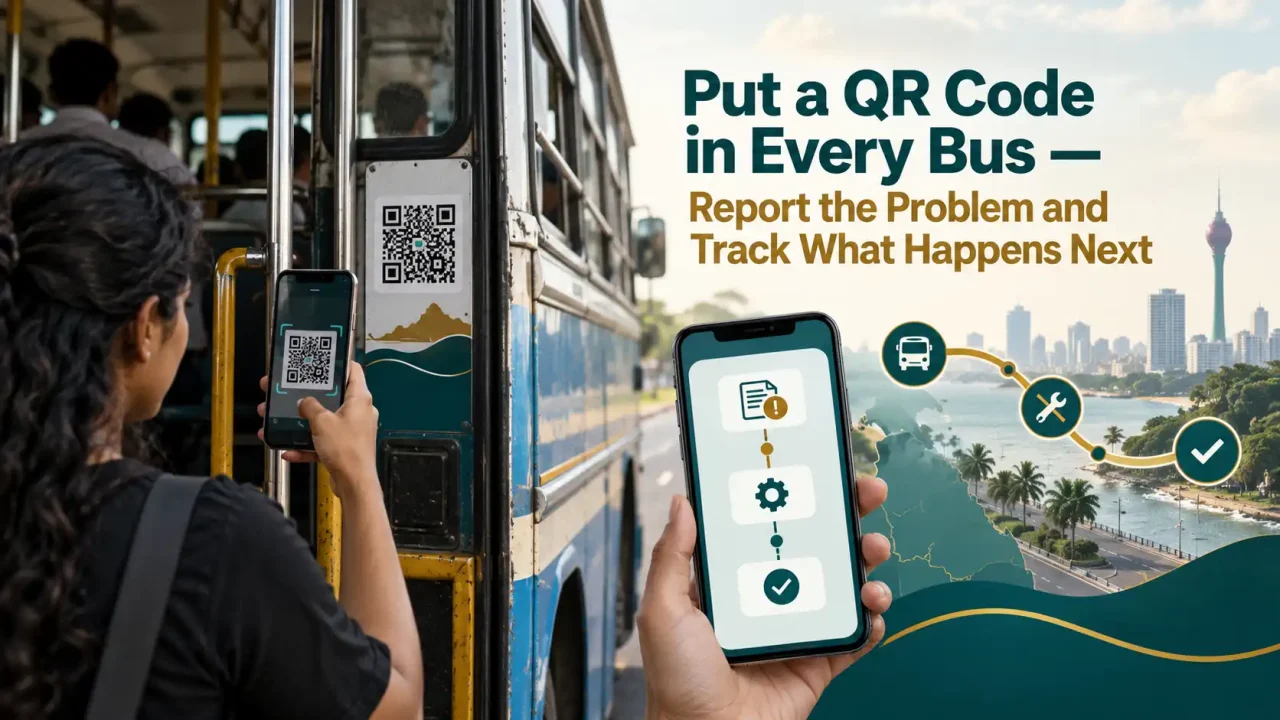
A bus is speeding dangerously. The driver is using a phone while driving. The conductor refuses to return your balance, doesn’t issue a ticket, behaves badly towards a passenger, or the bus deliberately crawls along waiting for more passengers.
Most passengers complain to the person next to them, post about it on Facebook, or simply forget about it after getting off.
Sri Lanka actually already has official ways to complain. The National Transport Commission (NTC) operates the 1955 hotline, accepts complaints through WhatsApp, and now has an online Complaint Management Portal.
The problem is that making a complaint should be much easier, connected automatically to the exact bus and trip, and transparent after it is submitted.
A simple improvement could make a big difference:
Put a unique QR code clearly inside every public bus.
Scan the bus, not search for its details
A passenger shouldn’t have to remember a registration number, search for the correct authority or figure out whether the bus comes under the NTC, a provincial transport authority or the SLTB.
Scan the QR code and the system should already know:
- Bus registration and permit number
- Route
- Operator
- Relevant transport authority
- Approximate trip/time
- GPS information, where available
The passenger then simply selects the problem.
Dangerous driving / speeding
Driver using a mobile phone
Not returning balance / overcharging
No ticket issued
Unnecessary stopping or intentionally driving too slowly
Rude or abusive behaviour
Overcrowding
Unsafe bus condition
Other
These aren’t imaginary problems. In 2023, the NTC recorded 6,036 public complaints. Among them were 1,098 complaints about excess fares or failure to return balances, 1,065 involving reckless driving, high speed, mobile-phone use or competitive driving, and 691 concerning failure to issue tickets. (NTC National Transport Statistics 2024)
Let passengers attach evidence
The complaint shouldn’t be limited to a small text box.
Passengers should be able to add:
- A photo
- Short video
- Voice recording
- Written description
- Location
- Approximate time
For something like speeding, GPS data from the bus could potentially be checked against the complaint instead of relying only on someone’s claim.
Passengers also shouldn’t be encouraged to start filming when doing so could put them in danger. Evidence could be uploaded after getting off the bus using the same QR link saved in their browser.
Give every complaint a status
Submitting a complaint into a black box isn’t enough.
After submitting it, the passenger should receive a case number and be able to see:
Received → Under Review → More Information Required → Referred to Authority → Action Taken / Closed
If an investigator needs clarification, they could ask a question through the same case:
What time did this happen?
Can you confirm where you boarded the bus?
Do you have the ticket or another photo?
The passenger could reply without starting another complaint or making another phone call.
The NTC already has some of these building blocks. Its current portal allows users to find complaint status, and previous NTC systems have issued inquiry numbers by SMS. So this does not need to be a completely new government IT project.
One system should route complaints to the right authority
This is particularly important in Sri Lanka because not every bus is regulated by the same organisation.
Historically, the NTC has handled complaints about inter-provincial buses while forwarding provincial-bus complaints to the appropriate provincial authority and SLTB complaints to the SLTB.
Passengers shouldn’t need to understand that structure.
The QR system should figure it out automatically.
But one complaint should not automatically punish a driver
The system also has to be fair.
A complaint is an allegation, not proof.
Bus crews should have an opportunity to respond. GPS, ticketing information and other evidence should be checked where available. Duplicate complaints from the same incident could be combined, and safeguards would be needed against malicious reports.
Photos, videos and personal information would also need clear privacy rules and secure storage.
But repeated verified complaints should matter.
If the same driver, conductor, bus or operator repeatedly receives valid complaints about dangerous driving or passenger treatment, regulators should be able to see that pattern immediately.
The NTC already considers public complaints and permit violations when dealing with bus operators, including during permit-related processes.
The technology required here is not particularly complicated.
One QR code. One simple complaint system. One trackable case.
The bigger change is giving passengers an easy way to report bad behaviour—and making sure that report doesn’t disappear after they press Submit.
Discuss this idea
Be the first to share your view.