
New VAT Invoice Format in Sri Lanka 2026: Requirements, Example & What Businesses Must Change
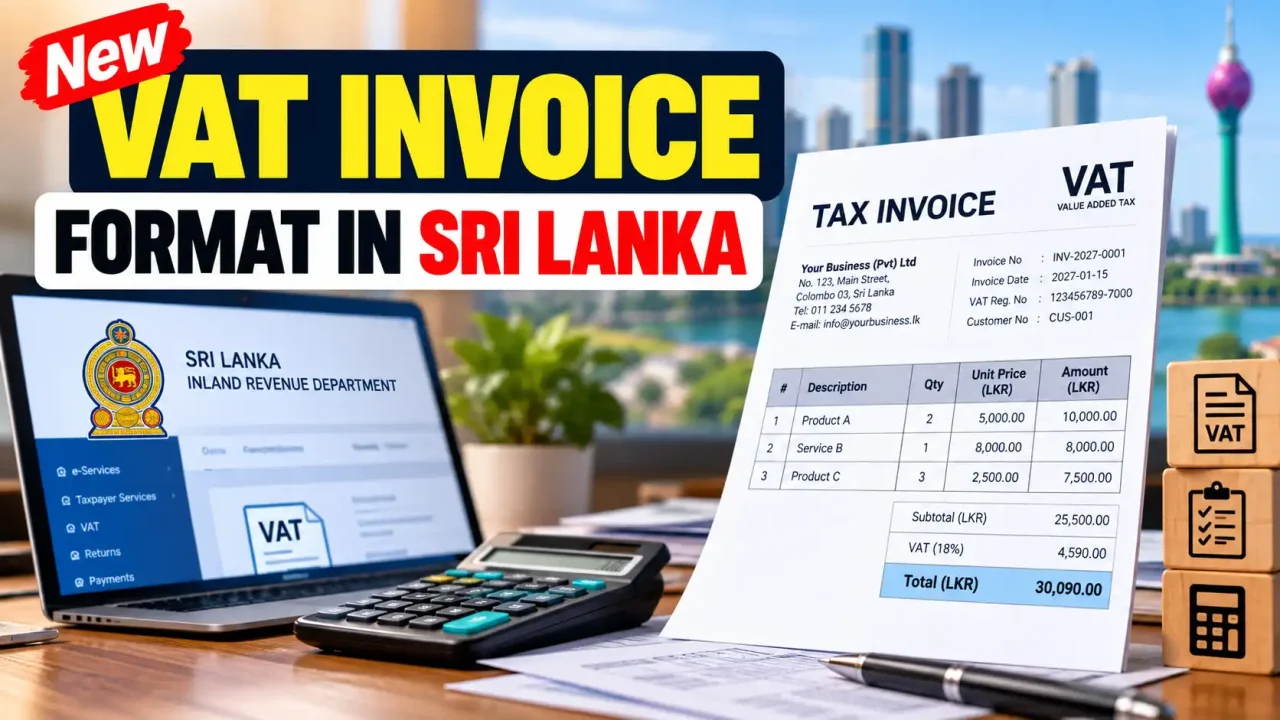
If your business is VAT-registered in Sri Lanka, simply showing your TIN, VAT amount and the words “Tax Invoice” on your existing invoice may no longer be enough.
A revised format and specification for VAT tax invoices became effective on 1 October 2026.
The requirement was originally scheduled to take effect on 1 July 2026. However, the Inland Revenue Department postponed the effective date to 1 October through Gazette Extraordinary No. 2500/106.
The underlying invoice specification itself comes from Gazette Extraordinary No. 2481/22 dated 27 March 2026.
For VAT-registered businesses, this means accounting systems, POS software, ERP systems, Excel invoice templates, printed invoice books and e-commerce invoice generators should now be checked against the official requirements.
And there are some details that are easy to miss — including a prescribed invoice-number structure, nine-digit supplier and purchaser TINs, a specific date format and a rule that the tax invoice should contain only supplies subject to VAT.
Here’s what businesses need to know.
Sri Lanka VAT Invoice Change: Quick Summary
| Requirement | From 1 October 2026 |
|---|---|
| Effective date | 1 October 2026 |
| Main Gazette | No. 2481/22 dated 27 March 2026 |
| Deadline amendment | Gazette No. 2500/106 dated 6 August 2026 |
| Invoice heading | TAX INVOICE |
| Supplier TIN | Required |
| Purchaser TIN | Required |
| TIN format | 9 digits |
| Invoice-number format | YYMMM_QQQQ_XXXXX |
| Spaces in invoice number | Not permitted |
| Maximum invoice-number length | 40 characters |
| Invoice date format | MM/DD/YYYY |
| Supply date format | MM/DD/YYYY |
| Currency | LKR |
| Monetary values | Two decimal places |
| VAT-exclusive amount | Required |
| VAT amount | Required |
| VAT-inclusive total | Required |
| Telephone numbers | Optional |
| Place of supply | Optional |
| Mode of payment | Optional |
| Total amount in words | Optional |
This article focuses on the VAT Tax Invoice prescribed by the Inland Revenue Department.
A normal commercial invoice and a VAT Tax Invoice aren’t automatically the same thing.
Why Did the Date Change to 1 October?
The revised format was initially scheduled to become effective from 1 July 2026 under Gazette No. 2481/22.
The Commissioner General of Inland Revenue subsequently issued Gazette Extraordinary No. 2500/106 on 6 August 2026.
That Gazette made a very specific amendment:
The effective date of 1 July 2026 was replaced with 1 October 2026.
Importantly, it also states that all other matters remain unchanged.
Therefore, the August Gazette didn’t introduce an entirely different invoice format.
It postponed the implementation date of the March specification.
As of 1 October 2026, businesses should therefore work from the requirements contained in Gazette No. 2481/22.
Does Every Sri Lankan Business Need to Use This Format?
No.
This is an important distinction.
The new specification relates to Tax Invoices issued under Sri Lanka’s VAT system by registered persons.
Being a registered business doesn’t automatically mean you’re VAT-registered.
According to the Inland Revenue Department, the general VAT registration threshold for taxable supplies other than financial services is currently:
- More than Rs. 15 million in a quarter, or
- More than Rs. 60 million during a 12-month period.
Voluntary VAT registration is also possible for a person carrying on taxable supplies, subject to the applicable rules.
Therefore, a small business that isn’t registered for VAT shouldn’t begin charging VAT simply because it sees the new invoice format.
Only a person entitled and required to account for VAT should charge it.
Sri Lanka’s standard VAT rate is currently 18%.
Tax Invoice vs Normal Invoice: An Important Difference
Another point businesses should understand is that not every invoice issued by a VAT-registered business is necessarily a “Tax Invoice” for VAT purposes.
Section 20 of the VAT Act deals specifically with tax invoices.
Under the VAT Act, where a registered supplier makes a taxable supply to another registered person who requests a tax invoice in accordance with the Act, the supplier issues the VAT Tax Invoice.
The Act also deals separately with supplies made to recipients who aren’t VAT-registered.
In such situations, the supplier may issue an invoice showing the total consideration including the tax charged, but that document isn’t automatically treated as a Tax Invoice for VAT purposes.
There are also specific rules relating to supplies to Government institutions and certain other bodies.
This distinction matters because the revised Gazette requires purchaser VAT-registration information, including the purchaser’s TIN.
If you’re uncertain about which document your particular transaction requires, confirm the treatment with the Inland Revenue Department or your tax adviser rather than inventing a purchaser TIN or leaving mandatory information blank.
1. The Invoice Must Clearly Say “TAX INVOICE”
The most visible requirement is straightforward.
The document must be prominently titled:
TAX INVOICE
The Gazette says the title should appear conspicuously on the face of the invoice using bold or highlighted text so that the document can be clearly identified.
Don’t hide “Tax Invoice” in small text in the footer.
A practical layout would place it prominently near the top of the document.
2. Supplier Details That Must Appear
The supplier information should appear at the top left-hand corner of the Tax Invoice.
The required supplier details are:
- Supplier’s TIN
- Supplier’s name
- Supplier’s address
The telephone number is optional.
The supplier’s details should correspond with the information in the VAT Registration Certificate.
Supplier TIN
The Gazette specifies the supplier’s Taxpayer Identification Number as a nine-digit TIN issued by the Commissioner General of Inland Revenue.
For example:
Supplier’s TIN: 123456789
The number above is only an illustrative example.
Don’t substitute another registration number simply because your old invoice template calls the field “VAT No.”
Check that the number being printed is the correct TIN required under the new specification.
3. Purchaser Details Are Also Required
The purchaser’s details should appear either at the top right-hand corner of the Tax Invoice or below the supplier’s information.
Required purchaser information includes:
- Purchaser’s TIN
- Purchaser’s name
- Purchaser’s address
Again, the telephone number is optional.
The Gazette specifies a nine-digit purchaser TIN.
For businesses that previously generated invoices using only a customer name and address, this is an important software and operational change.
You may now need your customer database to store the purchaser’s correct TIN.
Don’t Guess the Purchaser’s TIN
If your customer is requesting a VAT Tax Invoice, obtain their correct registration information.
Don’t:
- Invent a number.
- Use a company-registration number instead.
- Copy an old number without verification.
- Insert your own TIN in both fields.
- Fill the field with zeros simply to satisfy software validation.
Incorrect taxpayer information can defeat the purpose of the new standardised invoice system.
4. The New Invoice Number Format Is Very Specific
This is probably the biggest technical change for businesses using accounting software.
The prescribed Tax Invoice serial-number structure is:
YYMMM_QQQQ_XXXXX
Let’s break that down.
YY — Year
The first two characters represent the final two digits of the calendar year.
For 2026:
26
MMM — Month
Next comes the first three characters of the calendar month in uppercase.
Examples:
January → JAN
April → APR
October → OCT
December → DEC
So an invoice issued in October 2026 begins with:
26OCT
QQQQ — Organisational Code
The next section is an alphanumeric identifier that can be used to identify an organisational classification such as:
- Branch
- Section
- Unit
- Project
- Customer
- Other internal classification
For example, Branch 03 might use:
BR03
XXXXX — Numeric Serial Number
The final component is the actual invoice serial number.
This section must contain numerical characters only.
For example:
1
or:
00001
depending on how the business implements its sequence while complying with the specification.
Complete Example
An invoice issued in October 2026 by Branch 03 could therefore look like:
26OCT_BR03_1
The Gazette’s own example uses the same structure:
26JUL_BR03_1
for the first invoice issued by Branch 03 in July 2026.
Can the Invoice Number Contain Spaces?
No.
The Gazette specifically states that the complete Invoice Serial Number shouldn’t contain spaces.
So:
26OCT_BR03_1
would follow the illustrated structure.
But:
26 OCT BR03 1
would not.
The complete serial number is also limited to 40 characters.
Does the Invoice Number Need to Continue Every Month?
The Gazette states that the numeric serial number may continue from the number last issued in the preceding month.
However, where necessary, the numbering may also recommence at the beginning of each month or year.
That gives businesses some flexibility.
For example:
September’s final invoice:
26SEP_BR03_584
October’s first invoice could potentially continue:
26OCT_BR03_585
Alternatively, where the business has configured its system appropriately, numbering may recommence according to the permitted monthly or annual arrangement.
Whatever method you adopt, it should be systematic and controlled.
Avoid manually changing numbers in a way that produces duplicates.
5. Be Careful With the Date Format
This is an easy requirement to overlook in Sri Lanka.
Both the Date of Invoice and Date of Supply must be expressed in:
MM/DD/YYYY
That means 5 October 2026 should appear as:
10/05/2026
not:
05/10/2026
if you’re following the exact format specified in the Gazette.
Many Sri Lankan accounting systems and Excel sheets normally use DD/MM/YYYY.
So this is one field businesses should explicitly test after updating their invoice template.
6. Date of Invoice and Date of Supply Are Different Fields
The Tax Invoice must identify:
Date of Invoice — the date the invoice is issued.
Date of Supply — the date on which the goods or services were supplied.
These dates may sometimes be the same.
But your software shouldn’t assume they will always be identical.
For example:
Date of Supply: 10/03/2026
Date of Invoice: 10/05/2026
depending on the actual transaction and applicable VAT rules.
Don’t simply copy one date into both fields if that doesn’t reflect what actually happened.
7. Description of Goods or Services
The invoice must provide a clear description of the goods or services supplied.
Avoid vague line items such as:
“Service”
where a more meaningful description is reasonably available.
For example:
Website maintenance services – September 2026
is considerably more useful than:
Service
Likewise:
20 × Product ABC
is clearer than:
Goods
Good descriptions also make invoices easier for both businesses to reconcile later.
8. Quantity or Volume Must Be Included
The Gazette requires the measurable quantity or volume of the goods or services supplied.
For physical goods this could be straightforward:
10 units
25 kg
100 litres
For services, the appropriate measurable amount depends on the service.
Your accounting or invoicing system should be able to record an appropriate quantity rather than producing inconsistent blank values where the specification requires one.
9. Values Must Be Shown in Sri Lankan Rupees
The Gazette specifies that the value of supply should be stated in Sri Lankan Rupees (LKR).
Amounts should include cents and be expressed to two decimal places.
For example:
Rs. 100,000.00
rather than simply:
100000
The Tax Invoice should show three key amounts:
- Value of supply excluding VAT
- VAT charged
- Total consideration including VAT
Example: Rs. 100,000 Service + 18% VAT
Suppose your VAT-exclusive service charge is:
Rs. 100,000.00
At the current standard 18% VAT rate:
VAT:
Rs. 18,000.00
Total including VAT:
Rs. 118,000.00
Your invoice summary would therefore show:
| Description | Amount |
|---|---|
| Total Value of Supply | Rs. 100,000.00 |
| VAT @ 18% | Rs. 18,000.00 |
| Total Including VAT | Rs. 118,000.00 |
If you need to calculate VAT-exclusive or VAT-inclusive amounts, Peak Lanka’s Sri Lanka VAT Calculator – Add or Remove 18% VAT can help with the arithmetic.
Remember that some supplies can be exempt or zero-rated, so don’t automatically apply 18% to every transaction.
10. Tax Invoices Should Contain Only VAT-Subject Supplies
This is one of the most important requirements in the Gazette and could affect businesses selling a mix of taxable and exempt items.
The specification states that the Tax Invoice should exclusively include goods or services that are subject to VAT.
That means businesses shouldn’t automatically copy their existing mixed invoice format without checking how different types of supplies are being handled.
If one customer transaction contains supplies with different VAT treatments, obtain professional advice on the correct documentation and accounting treatment.
Don’t simply place exempt and VAT-subject supplies together on the new Tax Invoice because it’s convenient for your POS system.
11. Place of Supply Is Optional
The Gazette allows a Place of Supply field where the location at which the Tax Invoice is issued differs from the location from which delivery of the goods or services originates.
This field is optional.
For example:
Place of Supply: Kandy Branch
could be shown where relevant.
If it isn’t relevant to your transaction, the Gazette doesn’t make this field mandatory.
12. Mode of Payment Is Optional
The Tax Invoice may show the payment method.
Examples given in the Gazette include:
- Cash
- Bank Transfer
- Cheque
- Credit/Debit Card
- Mobile Payment
- Online Payment
If the actual payment method isn’t known when the invoice is issued, the expected method may be stated.
However, this field is optional.
Your accounting system doesn’t need to reject an otherwise valid invoice simply because the payment method hasn’t yet been decided.
Which Fields Are Optional?
Based on the official specification and sample invoice, optional information includes:
| Field | Status |
|---|---|
| Supplier telephone number | Optional |
| Purchaser telephone number | Optional |
| Place of supply | Optional |
| Additional information | Optional |
| Reference | Optional in official sample |
| Total amount in words | Optional |
| Mode of payment | Optional |
Businesses can also include additional information, rows or columns where necessary.
The supplier’s logo, trademark or other relevant header/footer information can also be included.
Can You Design Your Own Invoice Layout?
Yes.
You don’t need to reproduce the Gazette’s sample invoice pixel-for-pixel.
The Gazette describes the included layout as a specimen format.
Businesses may modify the appearance of the invoice as necessary, provided the document complies with the required specifications.
You can therefore still use:
- Your company logo
- Brand colours
- Additional columns
- Purchase-order references
- Internal project codes
- Payment terms
- Bank-account details
- Notes
- Other useful commercial information
But the design shouldn’t remove or contradict the mandatory VAT information.
A beautiful invoice that misses a mandatory field is still a compliance problem.
Example of the New Sri Lanka VAT Tax Invoice
Here’s a simplified example based on the IRD specification.
TAX INVOICE
Date of Invoice: 10/05/2026
Tax Invoice No.: 26OCT_BR03_1
Supplier
Supplier’s TIN: 123456789
Supplier’s Name: ABC Solutions (Pvt) Ltd
Address: Colombo, Sri Lanka
Purchaser
Purchaser’s TIN: 987654321
Purchaser’s Name: XYZ Trading (Pvt) Ltd
Address: Kandy, Sri Lanka
Date of Supply: 10/05/2026
| Description | Quantity | Unit Price | Amount Excluding VAT |
|---|---|---|---|
| Website maintenance service | 1 | Rs. 100,000.00 | Rs. 100,000.00 |
Total Value of Supply: Rs. 100,000.00
VAT @ 18%: Rs. 18,000.00
Total Including VAT: Rs. 118,000.00
The TINs and transaction above are fictional and are shown only to demonstrate the format. Businesses should use their actual registered information.
Your Old Invoice Might Not Be Compliant Even If It Calculates VAT Correctly
Suppose your current invoice already shows:
- Company name
- Customer name
- Invoice number
- Subtotal
- VAT
- Total
You might assume nothing needs to change.
But check again.
You could still be missing:
Purchaser TIN
Your customer record might not contain it.
Correct invoice-number structure
INV-1058 doesn’t follow the newly prescribed structure.
Date of Supply
Many invoice templates contain only an issue date.
Required MM/DD/YYYY date format
Your system may currently produce DD/MM/YYYY.
Quantity or volume
Some service invoices omit this.
Correct two-decimal LKR values
Your template may round or omit cents.
Separation of non-VAT supplies
Your POS system might place taxable and exempt items on the same Tax Invoice.
This is why businesses should review the entire workflow rather than simply edit the PDF header.
What Businesses Should Change Now
If you’re VAT-registered, go through each system that can create an invoice.
That might include:
- Accounting software
- ERP
- POS system
- WooCommerce or another e-commerce platform
- Custom internal software
- Mobile sales applications
- Excel templates
- Word templates
- Pre-printed invoice books
- Branch-level billing systems
Then verify the following.
1. Add Supplier TIN
Make sure the nine-digit TIN is stored centrally and printed correctly.
2. Add Purchaser TIN
Your customer form may need a new field.
Ideally, distinguish it from company-registration numbers and other IDs.
3. Replace the Invoice Number Generator
The invoice number needs to support:
YYMMM_QQQQ_XXXXX
For October 2026, for example:
26OCT_BR03_1
Don’t simply add 26OCT visually to the invoice while leaving another unrelated invoice number in the database.
The sequence should be implemented properly in the underlying accounting process.
4. Update Date Formatting
Set Tax Invoice dates to:
MM/DD/YYYY
Then test them.
A developer changing only the display format without checking imported dates or database parsing can create more serious accounting problems.
5. Store Date of Supply Separately
Don’t assume Invoice Date and Supply Date will always be identical.
6. Make the Document Clearly Say TAX INVOICE
This should be obvious on printed and PDF versions.
7. Check VAT Calculations
Verify:
- Net value
- VAT amount
- Gross amount
- Rounding
Peak Lanka’s existing VAT Calculator can be useful for manually checking examples.
8. Review Mixed VAT and Non-VAT Products
Check whether your system currently places everything onto one invoice regardless of tax treatment.
The Gazette specifically requires the Tax Invoice to contain supplies subject to VAT.
9. Test Every Branch
The organisational-code portion of the invoice number can identify branches or similar classifications.
If you operate several locations, test invoice generation from all of them.
10. Keep Appropriate Records
Don’t treat PDF generation as the entire compliance process.
Invoices need to be properly recorded, retained and reconciled with the business’s VAT accounting.
Important for WooCommerce and Online Stores
If your Sri Lankan VAT-registered business uses WooCommerce, Shopify or another e-commerce platform, don’t assume a generic invoice plugin automatically meets the new IRD specification.
Many international invoice plugins are designed around flexible formats such as:
INV-2026-1001
and don’t know about Sri Lanka’s prescribed structure:
26OCT_BR03_1
You may need customisation for:
- Supplier TIN
- Purchaser TIN
- Date of supply
- MM/DD/YYYY dates
- Sri Lankan invoice numbering
- Separate VAT-exclusive and VAT amounts
- VAT-only supply handling
- LKR formatting
- Branch or organisational codes
Before updating production, generate test invoices for different cases.
For example:
- One product
- Multiple products
- Discounted transaction
- Refund
- Different branch
- Different customer
- Month-end invoice
- First invoice of a new month
Also verify what happens when two invoices are generated simultaneously.
A poorly implemented custom invoice-number generator can create duplicate numbers under concurrent orders.
Important for Custom Software and ERP Systems
For developers, this shouldn’t be treated as merely a PDF-template change.
At minimum, consider whether your data model contains:
- Supplier TIN
- Purchaser TIN
- Invoice issue date
- Supply date
- Organisational code
- Numeric invoice sequence
- VAT-exclusive value
- VAT amount
- VAT-inclusive consideration
- Appropriate item quantity/volume
The invoice serial number should ideally be generated server-side within a reliable transactional process.
Avoid generating final legal invoice sequences only in JavaScript on the user’s browser.
Also consider:
- Duplicate prevention
- Audit history
- Invoice cancellation procedures
- Credit-note workflow
- Month/year rollover
- Branch-specific concurrency
- Backups
- Access control
- Preventing unauthorised invoice edits
Tax documents should not be silently regenerated with different numbers or amounts after being finalised.
If the business has complex invoice flows, involve its accountant or tax adviser when translating the legal requirements into software rules.
What About Peak Lanka’s Invoice Generator?
Peak Lanka already provides a Sri Lanka Invoice & Quotation Generator for creating simple LKR business documents.
However, it is important not to misrepresent what that tool currently does.
The existing tool itself states that a general invoice isn’t automatically an IRD Tax Invoice.
It doesn’t currently validate whether a user is VAT-registered or guarantee compliance with the prescribed VAT Tax Invoice format.
Therefore, VAT-registered businesses shouldn’t assume that generating an invoice with the existing tool automatically satisfies the new Gazette.
A dedicated Sri Lanka VAT Tax Invoice mode or separate VAT Invoice Generator would need to implement and validate the new requirements specifically.
That’s an important distinction for any online invoice generator — not just Peak Lanka’s.
What Happens to the Previous Invoice Format?
Gazette No. 2481/22 replaced the earlier format and specification issued under Gazette Notification No. 2463/05.
The March 2026 Gazette originally stated that the earlier format would remain optional and be rescinded when the new format became effective.
The August amendment changed the new effective date to 1 October 2026, while stating that all other provisions remained unchanged.
Businesses should therefore now be working from the current revised specification rather than continuing to rely on an older template indefinitely.
Do You Need to Reissue Old Invoices?
The October change concerns the effective date of the new specification.
It doesn’t mean businesses should automatically recreate every historical invoice issued under the rules applicable before the effective date.
Don’t renumber or regenerate historical accounting documents without a proper legal/accounting reason.
If you discover that an invoice issued after 1 October doesn’t comply, speak with your accountant or the IRD about the appropriate correction procedure rather than deleting the original document and silently generating another one.
Maintaining an accurate audit trail matters.
How Long Should VAT Tax Invoices Be Kept?
Section 20 of the VAT Act states that the original Tax Invoice is issued to the person receiving the supply, while the supplier retains the duplicate.
The supplier’s duplicate must be retained for five years after the expiry of the taxable period in which the invoice was issued.
This is another reason an online invoicing solution shouldn’t simply generate a PDF and forget about it.
Businesses need an appropriate record-retention process.
If you use cloud accounting software, make sure you understand:
- How long records are retained.
- Whether invoices can be exported.
- How backups work.
- Whether documents remain available if you stop paying for the software.
Can You Issue Another Tax Invoice If the Customer Loses It?
The VAT Act generally prohibits issuing more than one Tax Invoice for each supply.
Where the registered purchaser loses the original, the supplier may issue a copy clearly marked:
COPY ONLY
Therefore, don’t simply create another invoice with another invoice number for the same transaction.
Your accounting software should ideally support copies or reprints without generating a new legal invoice sequence.
Common Mistakes to Avoid
Using INV-001 as the Tax Invoice Number
The revised specification prescribes a specific structure.
Check your numbering system rather than assuming your existing sequential number remains acceptable.
Using DD/MM/YYYY
The Gazette specifies MM/DD/YYYY.
Leaving Out the Purchaser’s TIN
The purchaser details in the Tax Invoice specification include the nine-digit TIN.
Printing VAT-Inclusive Total Only
Show the value excluding VAT, VAT amount and total consideration including VAT.
Mixing Exempt Items Into the Tax Invoice
The new specification says Tax Invoices should contain only goods or services subject to VAT.
Calling Every Document a Tax Invoice
A quotation, pro-forma invoice, normal invoice and VAT Tax Invoice are different documents.
Assuming Your Accounting Software Has Already Been Updated
Check it yourself.
Software being popular doesn’t guarantee that its Sri Lankan invoice implementation has been updated correctly.
VAT Tax Invoice Compliance Checklist
Before issuing your next Tax Invoice, check:
-
Document clearly says TAX INVOICE
-
Supplier TIN is included
-
Supplier name is correct
-
Supplier address is correct
-
Purchaser TIN is included
-
Purchaser name is correct
-
Purchaser address is correct
-
Invoice number follows
YYMMM_QQQQ_XXXXX -
Invoice number contains no spaces
-
Invoice number is no longer than 40 characters
-
Date of Invoice uses MM/DD/YYYY
-
Date of Supply uses MM/DD/YYYY
-
Goods/services are clearly described
-
Quantity or volume is included
-
Values are shown in LKR
-
Amounts use two decimal places
-
VAT-exclusive value is shown
-
VAT amount is shown
-
VAT-inclusive total is shown
-
Tax Invoice contains only VAT-subject supplies
-
Optional fields are included only where useful
-
Invoice record is properly retained
If several of these items fail, don’t assume your invoice complies simply because the VAT calculation itself is correct.
New VAT Invoice Format FAQ
When did Sri Lanka’s new VAT Tax Invoice format become mandatory?
The revised effective date is 1 October 2026.
Gazette No. 2481/22 originally specified 1 July 2026, but Gazette No. 2500/106 changed that date to 1 October 2026.
What is the new VAT invoice-number format?
The prescribed structure is:
YYMMM_QQQQ_XXXXX
For example:
26OCT_BR03_1
Can there be spaces in the invoice number?
No.
The Gazette says the Invoice Serial Number should not contain spaces.
What is the maximum invoice-number length?
40 characters.
Is the purchaser TIN compulsory?
The revised Tax Invoice specification includes the purchaser’s nine-digit TIN as part of the required purchaser particulars.
If the recipient isn’t a VAT-registered purchaser, don’t invent a TIN. The VAT Act distinguishes between VAT Tax Invoices and invoices issued for supplies to non-registered recipients.
Is the telephone number mandatory?
No.
Supplier and purchaser telephone numbers are optional.
Is Place of Supply mandatory?
No.
It is an optional field under the new specification.
Is Mode of Payment mandatory?
No.
It is optional.
Do I need to write the total amount in words?
No.
The Gazette lists this as optional.
Can I add my company logo?
Yes.
The specification allows logos, trademarks and other relevant information in the invoice header or footer.
Can I change the design of the sample invoice?
Yes.
The official invoice shown in the Gazette is a specimen. You can modify the layout and add appropriate rows or columns as long as the resulting Tax Invoice conforms to the required specifications.
What is the VAT rate in Sri Lanka?
The current standard VAT rate is 18%.
However, individual supplies can be exempt, zero-rated or subject to specific rules, so don’t assume 18% applies to every transaction.
Does every business need to register for VAT?
No.
The general current registration threshold is taxable supplies exceeding Rs. 15 million in a quarter or Rs. 60 million during a 12-month period, subject to the VAT Act and specific rules. Voluntary registration is also possible in qualifying circumstances.
Can I use an Excel invoice?
The Gazette specifies the information and format requirements rather than requiring one particular accounting-software product.
An Excel-based invoice may therefore potentially be formatted appropriately, but the business is still responsible for compliant numbering, accurate records, duplicate prevention, retention and other VAT obligations.
For a growing VAT-registered business, manually maintaining legal invoice sequences in spreadsheets can create unnecessary risk.
What Should Businesses Do Now?
If you haven’t already updated your invoicing system, don’t wait until the next VAT return to investigate the issue.
Take one Tax Invoice generated by your current system and compare it field-by-field against the official Gazette.
Then check the underlying process.
Does the purchaser record contain the correct TIN?
Does October generate 26OCT correctly?
What happens when November begins?
What happens at invoice number 9999?
Can two staff members create duplicate invoice numbers?
Does your system accidentally use DD/MM/YYYY?
Can staff edit a completed invoice?
Can old invoices still be retrieved five years later?
Those operational questions can be just as important as the appearance of the PDF.
The new VAT Tax Invoice requirement isn’t simply a redesigned invoice template. For many businesses, it’s a change to the data, numbering and controls behind the invoice itself.
If you’re VAT-registered, has your accounting or POS software already been updated for the October 2026 format? And which part has been most difficult — purchaser TINs, invoice numbering, software changes or something else?
Last reviewed: 5 October 2026. This article is a practical explanation of the VAT Tax Invoice specification in Gazette Extraordinary No. 2481/22 and the effective-date amendment in Gazette Extraordinary No. 2500/106. It provides general information and isn’t personalised tax or legal advice. Businesses should verify their particular VAT treatment with the Inland Revenue Department or an appropriately qualified tax professional.