
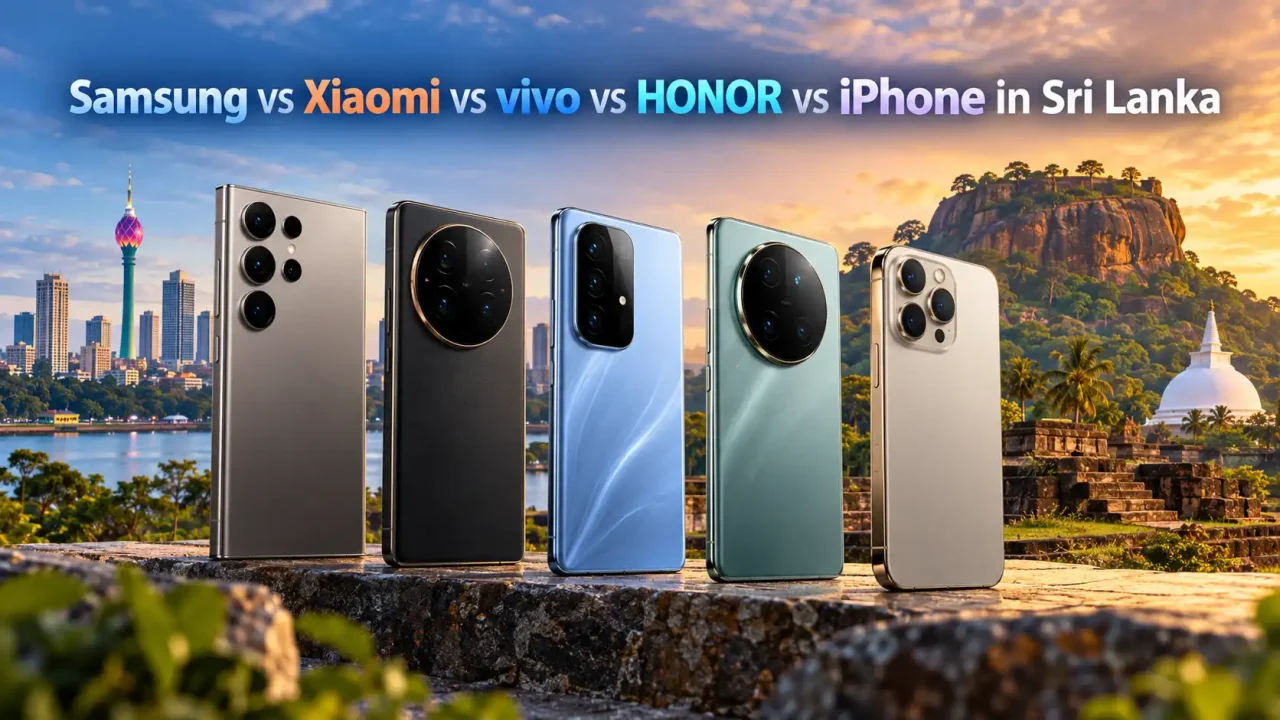
Samsung vs Xiaomi vs vivo vs HONOR vs iPhone in Sri Lanka: Which Should You Buy in 2026?
Quick Summary
There is no single “best” smartphone brand in Sri Lanka. Samsung is a strong all-round choice with good software support, while Xiaomi often offers more hardware and performance for the money. vivo is worth considering for cameras and battery life, and HONOR can offer competitive displays, batteries and specifications. iPhone makes the most sense if you prefer iOS, value video quality or already use other Apple devices.
Instead of choosing only by brand, compare phones within your actual budget and consider software updates, camera quality, battery life, warranty, repair costs and resale value. Sri Lankan buyers should also verify the warranty type and check the phone’s TRCSL/IMEI status before purchasing.
Ask this question in a Sri Lankan Facebook group, and you’ll probably start a smartphone war.
Some people insist that iPhones are worth their premium prices. Others believe Samsung offers a better Android experience. Xiaomi fans point to impressive specifications at competitive prices, while vivo and HONOR continue introducing phones with attractive cameras, large batteries and interesting features.
But here’s the real question: If you have Rs. 75,000, Rs. 150,000 or even Rs. 300,000 to spend on a smartphone in Sri Lanka, which one should you actually buy?
The answer depends on what you expect from your phone.
Someone who mainly uses WhatsApp, YouTube and banking apps has very different requirements from someone who plays demanding games, creates videos or plans to keep the same phone for five years.
Let’s compare five popular smartphone brands and identify which types of phones are worth considering for different needs and budgets.
First, What Does Each Brand Actually Offer?
Before comparing individual models, it’s useful to understand the different product ranges.
| Brand | Popular Product Ranges | What to Investigate |
|---|---|---|
| Samsung | Galaxy A and Galaxy S | Software support, overall experience, cameras and ecosystem |
| Xiaomi | Redmi, Redmi Note and Xiaomi flagships | Specifications, performance, charging and price |
| vivo | Y, V and X series | Battery life, portrait photography and camera features |
| HONOR | X, numbered series and Magic | Displays, battery life, cameras and flagship features |
| Apple | Standard iPhone, e models and Pro models | iOS, video recording, ecosystem and long-term ownership |
These are broad product categories, not guarantees about every model.
For example, comparing an entry-level Samsung Galaxy A phone with a Xiaomi flagship wouldn’t tell you much about which brand is better.
A fair comparison starts with two phones available at similar prices.
1. Samsung: A Balanced Android Experience
Samsung offers smartphones across several price categories, from affordable Galaxy A devices to premium Galaxy S models.
Its main attraction is the combination of hardware, One UI, security features and a relatively broad device ecosystem.
For someone who wants a familiar Android experience, Samsung is worth considering.
What Makes Samsung Attractive?
One of Samsung’s important advantages is its software-update commitment on eligible models.
For example, the Galaxy A57 and A37, announced in March 2026, qualify for up to six generations of operating-system upgrades and six years of security updates.
The flagship Galaxy S26 series offers seven generations of operating-system upgrades and seven years of security updates.
That’s particularly relevant if you’re planning to keep your phone for four or five years.
You can check Samsung’s official mobile security update information for supported models.
Samsung also provides features such as Secure Folder and Knox security, although availability varies by device.
Where Samsung Might Disappoint
Samsung doesn’t necessarily provide the most impressive specifications at every price point.
At a similar price, a competing Xiaomi or HONOR device might offer a larger battery, faster charging or a more powerful processor.
For example, someone primarily interested in gaming should compare the actual processors, cooling systems and gaming performance of similarly priced devices rather than choosing Samsung solely because of its reputation.
Consider Samsung if: You want a familiar Android interface, documented software support and an established product ecosystem.
2. Xiaomi: Specifications and Competitive Pricing
Xiaomi has built a reputation around offering attractive hardware specifications at competitive prices.
Its product range includes entry-level Redmi phones, mid-range Redmi Note devices and higher-end Xiaomi models.
For example, the Redmi Note 15 Pro 5G features a 6,580mAh battery, a 200MP main camera with optical image stabilisation and a large AMOLED display in its global specification.
Those are impressive specifications, but that doesn’t automatically mean it takes better photographs than every competing phone.
Check the official Redmi Note 15 Pro 5G specifications and confirm the specifications of the version being sold locally.
Why Xiaomi Is Worth Considering
Depending on the model, Xiaomi can offer attractive combinations of processing power, storage, screen quality, battery capacity and charging speed.
This makes it interesting for buyers who want to maximise hardware specifications within a fixed budget.
However, its product range is extensive. A standard Redmi device, Redmi Note Pro model and premium Xiaomi flagship may have substantially different cameras, processors and software-support periods.
What About HyperOS?
Xiaomi’s software experience is one area where personal preference matters.
Some users enjoy its customisation options and extensive features. Others prefer a simpler interface and may dislike promotional content or preinstalled applications on certain devices or regional software versions.
You should also investigate software support carefully.
Xiaomi’s general support policy states that devices typically receive at least two years of security updates, with longer periods available for certain models. Don’t assume that every recently released Xiaomi phone receives the same number of updates.
You can review its official software-update policy.
Consider Xiaomi if: You prioritise hardware specifications, performance or charging capabilities and are prepared to compare individual models carefully.
3. vivo: Photography, Battery Life and Everyday Use
vivo deserves consideration beyond its entry-level models.
Its Y series targets more affordable price categories, while the V series and premium X series offer additional camera features and more advanced hardware.
The X300 Pro, for example, is part of vivo’s premium photography-focused range.
Meanwhile, the V70 FE combines a 200MP stabilised main camera with a 7,000mAh battery and 90W charging, according to the specifications published for Sri Lanka.
You can compare the currently available models on vivo Sri Lanka’s official website.
What Makes vivo Interesting?
vivo’s V and X series are worth examining if photography matters to you.
Certain models offer portrait-oriented photography features, stabilised cameras and advanced image processing.
However, these capabilities vary considerably between models.
An affordable vivo Y-series phone shouldn’t be expected to deliver the same photographic experience as a premium X-series device.
Battery capacity is another area worth comparing. Several current vivo models feature large batteries, although real-world endurance depends on the processor, display, software and usage.
What Should You Check?
Pay attention to the exact processor, camera hardware and software-update commitment.
Don’t assume that a large battery or high-resolution main camera guarantees excellent performance across every category.
vivo publishes model-specific security-update information. Check the support details relevant to your intended device and market.
Consider vivo if: You regularly take portraits, family photographs or selfies, or want a phone with particular battery and charging features.
4. HONOR: An Alternative Worth Comparing
HONOR has expanded its smartphone range with devices offering large batteries, attractive displays, camera features and competitive specifications.
Its portfolio includes affordable X-series phones, mid-range numbered models and premium Magic-series devices.
For example, the HONOR 400 combines a 200MP stabilised main camera with an AMOLED display, while the more expensive Magic models target buyers looking for premium hardware.
You can explore the devices on HONOR’s Sri Lankan website.
What Makes HONOR Interesting?
Depending on the model, HONOR offers large batteries, bright displays and high-resolution cameras.
Its Magic-series flagships also compete directly with premium Samsung and Apple devices.
The brand has announced extended software support for certain devices. However, its original seven-year Magic-series commitment began in European markets, so Sri Lankan buyers should verify the precise policy for the model and region rather than assume it applies universally.
Check HONOR’s security-update information before buying.
What About Repairs and Resale?
An important consideration is whether you can obtain genuine replacement parts and reliable servicing for the particular model.
Before buying a premium HONOR device, especially an imported one, investigate the available service arrangements in Sri Lanka.
Also compare the resale demand for the exact model rather than assuming that every HONOR phone retains its value equally.
Consider HONOR if: A particular model offers the display, battery, camera or performance combination you want at a competitive local price.
5. iPhone: The Apple Ecosystem and a Different Software Experience
Apple takes a different approach from Android manufacturers.
Instead of offering dozens of models across every price category, it maintains a more focused iPhone range.
As of September 2026, its lineup includes the iPhone 17e, iPhone 17 family and newly released iPhone 18 Pro models.
The iPhone 17e provides an entry point into the current lineup, while the iPhone 18 Pro models introduce Apple’s latest premium camera and processing features.
Explore the current range on Apple’s official iPhone website.
Why Do People Choose iPhones?
One attraction is the integration between Apple’s hardware, software and other devices.
If you already own a MacBook, iPad or Apple Watch, features such as AirDrop, iCloud and Continuity can make an iPhone more convenient.
iPhones are also worth considering for video recording and content creation. However, an expensive iPhone Pro should be compared with similarly priced Android flagships rather than inexpensive mid-range devices.
What Are the Drawbacks?
Price is an obvious consideration, particularly in Sri Lanka.
Repair costs, accessories and replacement parts can also be substantial. Some buyers may prefer Android’s greater flexibility for file management, customisation and device choices.
Apple doesn’t publish a single identical software-support period for every iPhone. However, its September 2026 release of iOS 27 supports models going back to the iPhone 11 family.
That demonstrates substantial historical support, although it doesn’t guarantee how many additional updates a particular older model will receive.
Is an Older iPhone Better Than a New Android?
Not automatically.
At the same price, an older iPhone might offer attractive camera performance and the Apple ecosystem, while a brand-new Android phone could provide a fresh battery, original warranty, larger display and more modern connectivity.
If you’re considering an older device, compare its remaining software support and battery condition.
Consider iPhone if: You prefer iOS, use other Apple products, value its video features or want the particular experience offered by an iPhone model.
Which Phone Should You Choose Based on Your Requirements?
The following table provides a starting point for shortlisting phones rather than declaring a universal winning brand.
| Your Main Requirement | Phones Worth Investigating |
|---|---|
| Long-term software support | Supported Samsung Galaxy A/S models and recent iPhones |
| Gaming and processing power | Performance-focused Xiaomi devices and premium Samsung, HONOR or iPhone models |
| Portrait photography | vivo V/X models, iPhone and premium Samsung devices |
| Video recording | Recent iPhones and premium Samsung Galaxy S devices |
| Large battery and fast charging | Selected Xiaomi, vivo and HONOR models |
| Existing Apple ecosystem | iPhone |
| Android productivity and customisation | Samsung, Xiaomi and HONOR |
| Affordable everyday smartphone | Entry-level Redmi, Samsung, vivo and HONOR models |
These are editorial shortlists based on product features. A specific model may perform differently from other phones sold under the same brand.
What If Your Budget Is Below Rs. 100,000?
If you’re buying a phone for everyday use, you may not need to spend Rs. 150,000 or more.
For WhatsApp, YouTube, browsing, navigation and normal photography, several affordable Android devices can meet your needs.
However, consider getting enough storage and memory for your intended usage.
A phone with 128GB storage may be sufficient for someone who primarily streams media and uses cloud storage. Someone who takes frequent videos or installs large games could benefit from 256GB.
Don’t rely solely on advertised RAM figures. Some manufacturers include virtual RAM in their marketing, which is not equivalent to physical memory.
When comparing affordable models, prioritise adequate performance, suitable software support and a dependable warranty over unnecessary features.
Rs. 100,000–200,000: Where the Choices Become Interesting
This budget can open up a wider selection of mid-range Android devices and potentially older iPhones, depending on current local prices.
You may find phones with AMOLED displays, stabilised cameras, large batteries and relatively capable processors.
The important question becomes which features matter most.
For example, someone who plays demanding mobile games should investigate sustained performance and heat management. Someone who regularly photographs children or pets should examine moving-subject camera performance.
If you only use ordinary applications, spending substantially more for a powerful flagship processor may provide little practical benefit.
Also compare current local prices carefully. A discounted model from the previous generation can sometimes be more attractive than a newly released device with similar hardware.
Rs. 200,000–300,000: New Android or an iPhone?
This is a particularly interesting price category in Sri Lanka.
For context, Dialog’s online store listed the Samsung Galaxy A57 5G 12GB at approximately Rs. 258,000 in September 2026. It also listed older iPhones in a similar broad price range.
These are individual retailer listings, not market-wide prices, and can change with stock and promotions.
At this level, compare the phone’s long-term value instead of relying entirely on its brand.
Would you prefer a brand-new mid-range Android phone with a manufacturer-backed warranty or an older premium device?
A flagship from the previous generation could also be worth investigating if it has strong remaining software support and comes from a reliable seller.
Avoid assuming an older flagship is always superior. Battery condition, repair history, warranty coverage and software support can change the calculation considerably.
Above Rs. 300,000: Do You Actually Need a Flagship?
Premium smartphones offer increasingly capable cameras, processors, displays and additional software features.
However, their advantages aren’t equally valuable to everyone.
If your phone is mainly used for messaging, occasional photographs, banking and YouTube, you may struggle to justify spending substantially more than the price of a good mid-range device.
On the other hand, a professional content creator, mobile gamer or someone who depends heavily on their smartphone for work may benefit from certain flagship features.
Compare the actual capabilities you use.
For photography, consider the available lenses, stabilisation, low-light performance and video tools.
For gaming, assess sustained frame rates, thermal performance and battery consumption.
For productivity, examine multitasking, file handling, accessories and compatibility with your existing devices.
Don’t purchase a flagship simply because it has the highest specifications on a comparison website.
Four Things That Matter More Than Brand Loyalty
1. Software Updates
If you’re planning to keep a phone for four or five years, software support deserves serious attention.
Security updates help protect your device against newly discovered vulnerabilities.
This is particularly important if you regularly use mobile banking, payment applications or work-related accounts.
Compare the manufacturer’s documented support period for your exact model, including when that period started.
Also remember that Android operating-system upgrades and security updates aren’t necessarily delivered on the same schedule.
Explore Peak Lanka’s Mobile Banking Apps in Sri Lanka comparison for related information about digital banking.
2. Battery Life and Charging
A 7,000mAh battery looks more impressive than a 5,000mAh battery on paper.
But battery capacity alone doesn’t determine how long a phone lasts.
Processor efficiency, display brightness, background applications and software optimisation all affect real-world endurance.
Check independent battery tests for the exact models you’re comparing.
Likewise, a phone advertised with extremely fast charging may require a compatible proprietary charger to achieve its maximum speed.
Check whether that charger is included in the box and available locally.
3. Camera Performance
Don’t choose a smartphone camera based entirely on megapixels.
A 200MP camera doesn’t automatically outperform a 50MP camera.
Sensor size, lens quality, optical image stabilisation, image processing and software all influence the final result.
If photography is important to you, compare real sample photographs from the exact devices you’re considering.
Pay particular attention to indoor photographs, skin tones, moving subjects and low-light conditions.
If you’re interested in video recording, examine stabilisation, microphone quality, autofocus and sustained recording performance.
4. Resale Value and Repair Costs
A phone’s real cost isn’t just the amount you pay when purchasing it.
For example, suppose you purchase a phone for Rs. 200,000, use it for three years and sell it for Rs. 80,000.
Your net purchase cost would be Rs. 120,000, excluding accessories, repairs and other expenses.
Compare that with purchasing a Rs. 130,000 phone and selling it three years later for Rs. 30,000.
The second phone would have a net purchase cost of Rs. 100,000.
In this hypothetical example, the more expensive phone costs only Rs. 20,000 more over three years.
But resale prices are uncertain, and repairing an expensive flagship can eliminate that advantage.
Investigate the resale market, availability of replacement parts and likely repair costs before making a major purchase.
An Important Warning for Sri Lankan Buyers: Official Warranty vs Shop Warranty
In Sri Lanka, two shops may advertise what appears to be the same smartphone at significantly different prices.
Before assuming the cheaper option is the better deal, check the warranty.
An official manufacturer-backed local warranty and a warranty provided entirely by the selling shop aren’t necessarily equivalent.
An imported device may have been intended for another market, with different warranty arrangements, SIM configurations or regional software.
For Xiaomi, for example, its Sri Lankan warranty information directs customers to the final vendor for applicable after-sales service.
Before purchasing, ask exactly who will repair the phone if something goes wrong, whether genuine parts will be used and what documentation you need.
Don’t assume that an international warranty automatically provides free repairs in Sri Lanka.
Check TRCSL Approval Before Paying
Every buyer should also check the device’s IMEI and applicable TRCSL registration status.
To find your phone’s IMEI, enter:
*#06#
The Telecommunications Regulatory Commission of Sri Lanka provides an IMEI verification service through SMS number 1909.
Send an SMS using this format:
IMEI 123456789012345
Replace the example with the device’s actual 15-digit IMEI. Check both IMEIs where applicable.
You can read the official TRCSL mobile-device approval guidance.
A successful IMEI check doesn’t guarantee the phone’s authenticity, repair history or ownership status. It’s one important check among several.
Also verify whether the exact model supports your preferred Sri Lankan mobile network and SIM configuration, especially when buying imported devices.
Should You Buy a Used Flagship Instead?
A used flagship can offer premium features at a considerably lower price than when it was first released.
However, you also inherit the previous owner’s battery wear and potentially any hidden repair problems.
For a used iPhone, check Activation Lock, battery health and the available Parts and Service History.
For used Android phones, check factory-reset protection, any organisational management restrictions, the security patch level and all essential hardware.
If the price difference between a used flagship and a suitable new mid-range phone is small, consider whether the warranty and fresh battery justify purchasing new.
And don’t overlook the risk of buying a phone that’s close to the end of its software-support period.
So, Which Brand Should You Actually Buy?
There’s no universal answer to the Samsung versus iPhone debate, and Xiaomi, vivo and HONOR make the decision more interesting.
If you prefer Apple’s software and already own other Apple devices, an iPhone may fit your requirements.
If you prefer Android and want documented long-term support, investigate eligible Samsung devices alongside other manufacturers offering extended updates.
For buyers prioritising hardware specifications or charging capabilities, compare Xiaomi and selected HONOR or vivo models.
If photography is your main concern, examine the actual camera performance of similarly priced devices rather than assuming one brand always takes better photographs.
Most importantly, establish your budget before falling in love with a particular flagship.
The right smartphone is the one that meets your actual requirements at a price you can justify—not necessarily the newest, most expensive or most popular model.
Let’s settle the debate: Samsung, Xiaomi, vivo, HONOR or iPhone—which brand do you currently use, and would you buy the same brand again? What matters most to you: camera, battery life, performance, software, resale value or price?




Join the discussion
Start the discussion.